As some of you know, I have a very talented brother who is a
novelist, Bob. He's recently started a new blog and having read a particularly
meaty post, I thought it only appropriate to respond to his very important
query: What the Hell is Wrong With Us? Please read his original post on
BobAlpi.com.
My answer: Money.
Bob has hit upon something that's disgusted me
ever since I was introduced to tabloid newspapers by my friend's mom in ole
Bombay, NY. At first I thought it was a joke since my friend and I often
read MAD Magazine and watched Saturday Night Live. I soon found out
however that people actually read tabloids as news. Over ten years later,
it was start of the second Iraq war when my roommate was watching news about
it on her TV. I was aghast at the broadcast because it was the most sensational
newscast I'd ever seen while the pundits reported with actual excitement as movie
trailer-worthy graphics exploded across the screen. I thought it must have been a
tabloid show-- something out of a sci fi movie that used such news networks
as an illustration of the degradation of society. I thought the news was
very liberal. I had watched CNN now-and-then after the first Iraq war propelled the
network to the fore in '91 and thought this had a similar tone-- although far
more sensational. I asked my roommate what network it was-- FOX News. We
didn't get Fox where I grew up and when I moved to bigger TV
markets, I didn't watch much TV. I then learned it was supposed to
be the conservative voice in TV news. What? After what I saw?!
It was news marketed for easy consumption similar to propaganda, I
thought. I wonder now if the second Iraq war is what propelled Fox News to the fore.
Monday, May 9, 2011


Saturday, March 13, 2010
Something Awesome Happened
This week had it's trials, but you know what? There was a little bit of awesome in there. It certainly seems that sometimes in our lives it's hard to find the positive. But I'll bet there's at least a little bit of awesome in your life, too. You don't think so? Did you check?
 When we call our friends or family, conversation can often lead to commiseration or venting about work, school, life and significant others. In some cases, the entire conversation can be filled with all the unfortunate things that happened. And one conversation can string to several of the same tone. The same can happen in your inner dialog. But, was your year, month, week, day all bad? Perhaps, but I'd bet there were rays of sunshine in there. Sometimes though, you have to dig for them. It can be something as simple as a baby you saw at the store, the sound of the wind blowing through the trees or even the aroma of a cup of coffee. If we have to dig, is that a negative thing? Not at all. It may be that things really do suck the majority of the time, but there is a chance that it's just our perception making it seem like it does. For folks dealing with real issues like disease, death and other trauma, it certainly can seem that the world is coming down about them. Those are situations that need real help and not my simple thoughts, but I would wager that they wouldn't mind knowing little bits of awesome are still happening. In less severe cases, it can just feel like the world is against you. Nothing seems to come out right. Some might say that things are going wrong because you're following the wrong path. But, what if you can't change your path? You're stuck at your job in order to afford to feed your kids or maybe you're unemployed.... You love your husband, but he's not spending enough time, or too much, with you... Your grandmother has dementia and you have to care for her... These are all easily imagined or you live them every day. So ask yourself, when you call your mom or brother or best friend, do you just tell them about the negative? Do you not talk because you don't want to just vent? Venting is a healthy thing. If you have someone to vent to, you're a very lucky person (return the favor!) If you don't, find one! Just try to adopt this little habit: Be sure to toss in at least one event that was awesome.
For many of us, it can seem like there is no awesome happening to us. We tell ourselves there's nothing good and eventually, we make it a reality. We keep looking out from the shadows only to see more shadows. That's when you have to start picking out the pools of light. Challenges and difficulties will be a constant and you'll need to keep working through them for sure. Yet perhaps every week or every day, take a moment to reflect and find whatever either brought you or will bring you a little joy. Find the something awesome that happened and eventually, there will be a whole lot of awesome in your life.
Photo by Nathan Linn
 When we call our friends or family, conversation can often lead to commiseration or venting about work, school, life and significant others. In some cases, the entire conversation can be filled with all the unfortunate things that happened. And one conversation can string to several of the same tone. The same can happen in your inner dialog. But, was your year, month, week, day all bad? Perhaps, but I'd bet there were rays of sunshine in there. Sometimes though, you have to dig for them. It can be something as simple as a baby you saw at the store, the sound of the wind blowing through the trees or even the aroma of a cup of coffee. If we have to dig, is that a negative thing? Not at all. It may be that things really do suck the majority of the time, but there is a chance that it's just our perception making it seem like it does. For folks dealing with real issues like disease, death and other trauma, it certainly can seem that the world is coming down about them. Those are situations that need real help and not my simple thoughts, but I would wager that they wouldn't mind knowing little bits of awesome are still happening. In less severe cases, it can just feel like the world is against you. Nothing seems to come out right. Some might say that things are going wrong because you're following the wrong path. But, what if you can't change your path? You're stuck at your job in order to afford to feed your kids or maybe you're unemployed.... You love your husband, but he's not spending enough time, or too much, with you... Your grandmother has dementia and you have to care for her... These are all easily imagined or you live them every day. So ask yourself, when you call your mom or brother or best friend, do you just tell them about the negative? Do you not talk because you don't want to just vent? Venting is a healthy thing. If you have someone to vent to, you're a very lucky person (return the favor!) If you don't, find one! Just try to adopt this little habit: Be sure to toss in at least one event that was awesome.
For many of us, it can seem like there is no awesome happening to us. We tell ourselves there's nothing good and eventually, we make it a reality. We keep looking out from the shadows only to see more shadows. That's when you have to start picking out the pools of light. Challenges and difficulties will be a constant and you'll need to keep working through them for sure. Yet perhaps every week or every day, take a moment to reflect and find whatever either brought you or will bring you a little joy. Find the something awesome that happened and eventually, there will be a whole lot of awesome in your life.
Photo by Nathan Linn
Wednesday, March 18, 2009
Sci Fi Channel and the Death of Science Fiction TV
 Bye bye Sci Fi.
If you haven't heard, Sci Fi Channel has announced that they're changing their name to SyFy Channel in an attempt to broaden their audience. What we have to remember however, is this is about dollars, not geeks.
From TVWeek.com:
“We spent a lot of time in the ’90s trying to distance the network from science fiction, which is largely why it’s called Sci Fi,” said TV historian Tim Brooks, who helped launch Sci Fi Channel when he worked at USA Network.
Looking passed the fact that "sci-fi" and "science fiction" are synonyms in the vernacular (as much as Harlan Ellison hates it), this statement still doesn't quite jive with reality. Sci Fi Channel started in 1992 under an advisory board including Star Trek creator Gene Roddenberry, author Isaac Asimov and if my memory of the comic book ads is correct, actor Leonard Nimoy.
 A joint venture of Paramount Pictures, USA Networks, and Universal Pictures, the whole point of the channel was to rerun old science fiction shows and movies of which the studios had many. It was to be a celebration of science fiction although, I personally didn't know if there was enough applicable programming to support an entire channel. These days, you can catch an episode or series online or on DVD, but in those days, if you missed a show, it was possible that you'd never see it again. So at the time, the chance to see Twilight Zone, original Battlestar Galactica and Buck Rogers in the 25th Century was pretty darn cool. Unfortunately, we didn't get the channel at the time and I was relegated to reading about it in Wizard Magazine. Brooks' claim that they were trying to distance themselves doesn't seem to ring true until the 21st Century. Until that time they did run a lot of horror, but I still caught Star Trek, Space Above and Beyond and Babylon 5 through the turn of the century. Prime time on Friday nights (oft called SciFridays) was their most advertised lineup and has contained much of their original programming like Farscape, Stargate SG-1/Atlantis, Battlestar Galactica, Andromeda and The Secret Adventures Of Jules Verne plus, Dr Who (BBC). Sounds pretty science fictiony to me. Even some of their largest ventures were two massive Dune mini-series. Still, direct-to-video quality horror movies, paranormal programs like John Edwards and Ghost Hunters and reality shows were creeping in around 2000. And meanwhile, science fiction was disappearing from American networks.
Wednesday, January 7, 2009
Gaming Beyond DirectX?
I know a little about video game engines and such, but I thought I'd submit this to my readers to see if maybe you could help me with the gaps in my knowledge. As some may know, I'm not happy with DRM and resource heavy Windows Vista and I'm wondering what might happen in the PC gaming world when Microsoft stops selling XP. Mainly, the question is, can OpenGL completely replace DirectX 10+? Mac, Unix, GNU, Linux all use OpenGL, but looking into DirectX, it would seem it's more powerful than OpenGL when matched with the right GPU (Graphics Processing Unit.) DirectX 10 is supposed to be fast and streamlined, which is cool, but it's only on Vista. The thing is, both OpenGL and Direct X use the same Shader Model. Does that mean OpenGL has the same abilities? I speak mainly of the amazing texturing and displacement mapping now possible with engines like the Unreal Engine 3. From what I have read, that engine was built for DirectX 9 (and patched to 10) so, I don't know how viable OpenGL is on "next generation" platforms. Then again, Call of Duty 4 is on Intel Macs and doesn't seem to take a hit graphically (although I've never played it on an Mac so, I'm not an authority.) So, anyone have the skinny this stuff?
Wednesday, December 17, 2008
Tension! Tension! Tension!
A conversation on how tension and taking a second look at your writing can give it more HECK YEAH!
 In working on an alternative future feature-length screenplay with writing partner Tom Mercer, I recalled something I had been talking to comic book artist Rick Arthur about. Rick, a great writer in my opinion, and I have had long conversations on tension. At the time, I had been working on a different script and in trying to "up the stakes," I wrote a scene that happened to have a similar fight to a later scene. I suppose that other people, looking at the recent crop of lack-luster action adventure films, would have left it as was, but I knew the earlier fight would take away from the later one and worked hard to fix them. Thankfully, I was able come up with a solid solution that achieved all the plot points, but in a different way. This reminded me of one of the talks Rick and I had about Star Wars: Episode II Attack of the Clones and suggestions he had for the gladiator scene (you know, the one with the three beasts who were to eat up Obi-Wan, Anakin and Padmé.) Lately I've been rolling my eyes at films like Pirates of the Caribbean II and III and X-Men III for they're trade-in of story for special effects and because the films failed to utilize their genre roots. Attack was also guilty of this and Rick told me it was because they attempted an homage to gladiator movies, but didn't do the classic arena scene justice. As he and I talked about, it also showed gross negligence in not seizing the possible tension nor the possible plot points. Not to droll on about the Prequels, but I almost wish I could somehow redo that scene to show how it could have worked. Hopefully Rick doesn't mind me mixing in his ideas in the following description of how I might change such a scene...
 In working on an alternative future feature-length screenplay with writing partner Tom Mercer, I recalled something I had been talking to comic book artist Rick Arthur about. Rick, a great writer in my opinion, and I have had long conversations on tension. At the time, I had been working on a different script and in trying to "up the stakes," I wrote a scene that happened to have a similar fight to a later scene. I suppose that other people, looking at the recent crop of lack-luster action adventure films, would have left it as was, but I knew the earlier fight would take away from the later one and worked hard to fix them. Thankfully, I was able come up with a solid solution that achieved all the plot points, but in a different way. This reminded me of one of the talks Rick and I had about Star Wars: Episode II Attack of the Clones and suggestions he had for the gladiator scene (you know, the one with the three beasts who were to eat up Obi-Wan, Anakin and Padmé.) Lately I've been rolling my eyes at films like Pirates of the Caribbean II and III and X-Men III for they're trade-in of story for special effects and because the films failed to utilize their genre roots. Attack was also guilty of this and Rick told me it was because they attempted an homage to gladiator movies, but didn't do the classic arena scene justice. As he and I talked about, it also showed gross negligence in not seizing the possible tension nor the possible plot points. Not to droll on about the Prequels, but I almost wish I could somehow redo that scene to show how it could have worked. Hopefully Rick doesn't mind me mixing in his ideas in the following description of how I might change such a scene...
Tuesday, November 25, 2008
Frozen River: A Film Funded by the Kindness of Forgotten Strangers
The humble beginnings of the award winning feature film and the amazing crew it was founded on.
 Making independent film is hard. Damn hard. When starting out making their first films, most filmmakers have little money and have to rely, at least partially, on the kindness of strangers. As anyone who has tried it knows, without a substantial budget it's difficult to afford to pay your cast and crew. I know this from personal experience. I've been lucky enough to have had individuals willing to stand in the cold and the heat to aid me in such endeavors. And I've tried my best not to forget them. The crew of Frozen River I'm afraid, was forgotten long ago.
It has been a long time since I aided the first narrative film I've ever known to shoot in the region I grew up in. I was reminded of the shoot by an interview by Liane Hansen with Frozen River star Melissa Leo on National Pubic Radio's Weekend Edition Sunday. Leo makes mention of the short film (of the same name) which was shot back in the winter of 2004. The progenitor of the Sundance Film Festival Grand Jury Prize winning feature, also written and directed by Courtney Hunt, was filmed on locations in and around the Akwesasne Mohawk Nation in Northern New York. No, you won't find it on IMDB even though it traveled the festival circuit and won funding for the feature at the IFP film market. From Hunt's website:
"The film premiered at the New York Film Festival in 2004, and went on to screen at numerous other festivals, including the Los Angeles Film Festival, Nashville, Williamstown, and the American Indian Film Festival in San Francisco."
There isn't anywhere on the internet that I know of where you read about the twenty-eight-plus crew who largely volunteered their time. (The names I know are listed at the end of this article.) You also can't read about Upstate Independents, a filmmaker's organization in Albany, NY, where Hunt asked for and received free help and crew, including myself, from its members. You can't find anything about the months of preparation done by Debra, Al and Amanda, Hunt's intrepid pre-production team, to gather a crew in what can be easily considered a remote location. Being originally from the area, I helped to connect them with the local high school and businesses.
As is customary in indie film, the agreement between Hunt and I was in return for working on the short for free, I would receive lodging and meals during the shoot, credit and if the short ever garnered her a feature film deal, I would be amongst the first to be called to work on it for pay. This was the same agreement given to the entire crew including those who were paid at a discounted rate. To my knowledge, none of the members of that crew were ever contacted when the short won Hunt funding. The only individuals I know from the short to work on the feature, were actors. I've also never seen the short. There was one screening that we were told about, but that was too long a drive for me to make. In all, I received three emails from Hunt early on, but that was it. One of them thanked us for our hard work, which I did appreciate. But, I would have appreciated if she had honored our agreement a whole lot more.
"Courtney wrote and directed Frozen River, the short film, starring Melissa Leo and Misty Upham, which was shot in sub-zero weather on the Canadian border in Upstate New York."
Yes, it was cold. We filmed for five nights in all. We shot outside of Massena at Bob's Motel, over near Hogansburg at the Wolf Pack, down near the St. Lawrence River off Garrow Rd. and actually on the river ice. For those of you who are unfamiliar, a normal shift on a film set is twelve hours. Sid, our tough, prideful Gaffer, Ryan, our towering bright Key Grip-turned-First Assistant Director and myself, the lone Grip were the first to arrive in the early afternoon and the last to leave the set in the wee morning hours. The three of us put in more hours on set (sometimes working over 15 hours) than anyone so, yeah, it was cold. Eddie, Ryan, Sid and myself also drove the trucks. The food on the shoot was fantastic, though. I wish I could recall Melissa-the-Chef's last name. The Production Assistants who helped her were also awesome. Actually, everyone was awesome. Camera, Grip and Electric, Art, Production... everyone.
Through all the frigid, long hours no one complained. Not a one. Ryan was even sick, yet he soldiered on. The next to last night when we filmed at the old camper, I recall looking around at all the crew who occupied probably a sixty-foot radius around the car we were filming in. Each of us dressed in at least three layers of clothing waited patiently and quietly standing steadfast in the cold. I realized; here we were in the middle of the night, in the middle of no where, standing on inches of snow and ice, freezing our asses off, for over twelve hours a day... mostly for free. I was astonished by the kindness of all of these individuals to do this for someone they don't even know-- at least not well. That's when I realized how many films like this rely heavily on the kindness of others. There were even a few times when the dedication of the crew was brought into question (not by the director), but there was absolutely no questioning our dedication and Hunt later told us as much. Through it all, the crew just kept doing their jobs silently and respectfully. Hunt did tell us many times how much she appreciated our efforts and what an awesome job we were doing. We shot a lot of film and from what I heard, the footage was amazing. Therefore, I cannot believe there is any performance-related or other legitimate reason why none of us received any word what-so-ever about the feature (if even to tell us somehow the situation barred her from bringing us on.) I am proud of my efforts on the short and enjoyed working with that exceptional group of people. It is only the lack of follow-through that I have any issue with. And not really for me, but for the entire crew from the students from St. Lawrence University, to the long time pro's from around the Northeast. They deserve recognition for their great effort and their contribution to getting the feature funded. At the least, I feel it's time their existence was known. Unfortunately this is a similar story to countless others in independent film, but luckily I have the ability do a little something to ensure these folks aren't totally forgotten. Hopefully knowing about this will encourage future filmmakers to honor their agreements and give their crew the credit they deserve. The following is a partial list of credits for the short film Frozen River. My thanks to all the cast and crew for their camaraderie and excellent achievement on the frozen border of a great Nation.
Frozen River (2004)
Written & Directed by
Courtney Hunt
Produced by
Don Harwood
Courtney Hunt
Director of Photography
Marc Blandori
Edited by
Tony Grocki
Line Producer
Debra Pearlman
Production Manager
Amanda Brooks
First Assistant Assistant Director
Al Halstead
First Assistant Assistant Director
Ryan Gates
Script Supervisor
Kevin Craig West
Second Assistant Director
Deb Shufelt
First Assistant Camera
Eddie Rodriguez
Second Assistant Camera
Jill Maouf
Gaffer
Sal Martarano
Key Grip
Ryan Gates
Mark Sasahara
Grip
Ben Alpi
Sound Mixer
Martin G. Kelly
Boom Operator
Bret Lafontan
Location Scout
Tim Schneider
Props Artists
Len X. Clayton
Andy Dorr
Chuck Robeland
Prop Master
Josh Wyman
Wardrobe
Kristin Edwards
Key Production Assistant
Mike Camoin
Assistants to the Director
Patty Mason
Amanda Crowley
Production Assistants
Tim Gallivan
Travis Wyman
Etienne Gupta
Brian Willmert
Micah Warren
Special Thanks
(This is a list of people I would think need thanking)
St. Regis Mohawk Tribe
St. Lawrence University
Upstate Independents
Thomas Mercer
Katsitsionni Fox
Salmon River Central School
Bob's Motel, Massena, NY
(photo: Ben Alpi (rt) and Kevin Craig West, courtesy Jill Maouf. )
Anyone with corrections, additional information or photos, please comment and let me know!
 Making independent film is hard. Damn hard. When starting out making their first films, most filmmakers have little money and have to rely, at least partially, on the kindness of strangers. As anyone who has tried it knows, without a substantial budget it's difficult to afford to pay your cast and crew. I know this from personal experience. I've been lucky enough to have had individuals willing to stand in the cold and the heat to aid me in such endeavors. And I've tried my best not to forget them. The crew of Frozen River I'm afraid, was forgotten long ago.
It has been a long time since I aided the first narrative film I've ever known to shoot in the region I grew up in. I was reminded of the shoot by an interview by Liane Hansen with Frozen River star Melissa Leo on National Pubic Radio's Weekend Edition Sunday. Leo makes mention of the short film (of the same name) which was shot back in the winter of 2004. The progenitor of the Sundance Film Festival Grand Jury Prize winning feature, also written and directed by Courtney Hunt, was filmed on locations in and around the Akwesasne Mohawk Nation in Northern New York. No, you won't find it on IMDB even though it traveled the festival circuit and won funding for the feature at the IFP film market. From Hunt's website:
"The film premiered at the New York Film Festival in 2004, and went on to screen at numerous other festivals, including the Los Angeles Film Festival, Nashville, Williamstown, and the American Indian Film Festival in San Francisco."
There isn't anywhere on the internet that I know of where you read about the twenty-eight-plus crew who largely volunteered their time. (The names I know are listed at the end of this article.) You also can't read about Upstate Independents, a filmmaker's organization in Albany, NY, where Hunt asked for and received free help and crew, including myself, from its members. You can't find anything about the months of preparation done by Debra, Al and Amanda, Hunt's intrepid pre-production team, to gather a crew in what can be easily considered a remote location. Being originally from the area, I helped to connect them with the local high school and businesses.
As is customary in indie film, the agreement between Hunt and I was in return for working on the short for free, I would receive lodging and meals during the shoot, credit and if the short ever garnered her a feature film deal, I would be amongst the first to be called to work on it for pay. This was the same agreement given to the entire crew including those who were paid at a discounted rate. To my knowledge, none of the members of that crew were ever contacted when the short won Hunt funding. The only individuals I know from the short to work on the feature, were actors. I've also never seen the short. There was one screening that we were told about, but that was too long a drive for me to make. In all, I received three emails from Hunt early on, but that was it. One of them thanked us for our hard work, which I did appreciate. But, I would have appreciated if she had honored our agreement a whole lot more.
"Courtney wrote and directed Frozen River, the short film, starring Melissa Leo and Misty Upham, which was shot in sub-zero weather on the Canadian border in Upstate New York."
Yes, it was cold. We filmed for five nights in all. We shot outside of Massena at Bob's Motel, over near Hogansburg at the Wolf Pack, down near the St. Lawrence River off Garrow Rd. and actually on the river ice. For those of you who are unfamiliar, a normal shift on a film set is twelve hours. Sid, our tough, prideful Gaffer, Ryan, our towering bright Key Grip-turned-First Assistant Director and myself, the lone Grip were the first to arrive in the early afternoon and the last to leave the set in the wee morning hours. The three of us put in more hours on set (sometimes working over 15 hours) than anyone so, yeah, it was cold. Eddie, Ryan, Sid and myself also drove the trucks. The food on the shoot was fantastic, though. I wish I could recall Melissa-the-Chef's last name. The Production Assistants who helped her were also awesome. Actually, everyone was awesome. Camera, Grip and Electric, Art, Production... everyone.
Through all the frigid, long hours no one complained. Not a one. Ryan was even sick, yet he soldiered on. The next to last night when we filmed at the old camper, I recall looking around at all the crew who occupied probably a sixty-foot radius around the car we were filming in. Each of us dressed in at least three layers of clothing waited patiently and quietly standing steadfast in the cold. I realized; here we were in the middle of the night, in the middle of no where, standing on inches of snow and ice, freezing our asses off, for over twelve hours a day... mostly for free. I was astonished by the kindness of all of these individuals to do this for someone they don't even know-- at least not well. That's when I realized how many films like this rely heavily on the kindness of others. There were even a few times when the dedication of the crew was brought into question (not by the director), but there was absolutely no questioning our dedication and Hunt later told us as much. Through it all, the crew just kept doing their jobs silently and respectfully. Hunt did tell us many times how much she appreciated our efforts and what an awesome job we were doing. We shot a lot of film and from what I heard, the footage was amazing. Therefore, I cannot believe there is any performance-related or other legitimate reason why none of us received any word what-so-ever about the feature (if even to tell us somehow the situation barred her from bringing us on.) I am proud of my efforts on the short and enjoyed working with that exceptional group of people. It is only the lack of follow-through that I have any issue with. And not really for me, but for the entire crew from the students from St. Lawrence University, to the long time pro's from around the Northeast. They deserve recognition for their great effort and their contribution to getting the feature funded. At the least, I feel it's time their existence was known. Unfortunately this is a similar story to countless others in independent film, but luckily I have the ability do a little something to ensure these folks aren't totally forgotten. Hopefully knowing about this will encourage future filmmakers to honor their agreements and give their crew the credit they deserve. The following is a partial list of credits for the short film Frozen River. My thanks to all the cast and crew for their camaraderie and excellent achievement on the frozen border of a great Nation.
Frozen River (2004)
Written & Directed by
Courtney Hunt
Produced by
Don Harwood
Courtney Hunt
Director of Photography
Marc Blandori
Edited by
Tony Grocki
Line Producer
Debra Pearlman
Production Manager
Amanda Brooks
First Assistant Assistant Director
Al Halstead
First Assistant Assistant Director
Ryan Gates
Script Supervisor
Kevin Craig West
Second Assistant Director
Deb Shufelt
First Assistant Camera
Eddie Rodriguez
Second Assistant Camera
Jill Maouf
Gaffer
Sal Martarano
Key Grip
Ryan Gates
Mark Sasahara
Grip
Ben Alpi
Sound Mixer
Martin G. Kelly
Boom Operator
Bret Lafontan
Location Scout
Tim Schneider
Props Artists
Len X. Clayton
Andy Dorr
Chuck Robeland
Prop Master
Josh Wyman
Wardrobe
Kristin Edwards
Key Production Assistant
Mike Camoin
Assistants to the Director
Patty Mason
Amanda Crowley
Production Assistants
Tim Gallivan
Travis Wyman
Etienne Gupta
Brian Willmert
Micah Warren
Special Thanks
(This is a list of people I would think need thanking)
St. Regis Mohawk Tribe
St. Lawrence University
Upstate Independents
Thomas Mercer
Katsitsionni Fox
Salmon River Central School
Bob's Motel, Massena, NY
(photo: Ben Alpi (rt) and Kevin Craig West, courtesy Jill Maouf. )
Anyone with corrections, additional information or photos, please comment and let me know!
Wednesday, November 19, 2008
A Quick Word for Those in Waiting
A quick note to those of us interested in one day having a relationship, but are still sitting on the sidelines and to those who are trying to get back on that horse.
If you truly want to share your love with someone, don't wait. You will make mistakes. You will fail. You will cry. It will hurt sometimes. But it is also one of the most glorious, fulfilling and exciting things you'll ever have the pleasure of doing. Risk is an unavoidable part of life. You're scared of what could happen, that's totally understandable. You're afraid of failing or of succeeding. Why would someone be interested in ME? How could someone totally be into just hanging out with me? Want to love me? Care about what I do and what I think? What if all they want is my body? To tell you the truth, it is kind of weird, even shocking, to realize someone is content just to stare into your eyes. But, when it's genuine, it's amazing. So, you've put a lot of thought into this. You've convinced yourself that you have too many quirks to succeed. You're too busy to cultivate a meaningful relationship. Well, what if you're wrong? Reality is always different from what we predict. It will surprise you how much so, actually. You'll surprise yourself, too. As you think back to all the reasons against having a relationship, I'll bet you honestly feel at least a little differently about most or all of them if not outright disagree with some of them. We all need to take our own time in life and love. No one can criticize you for doing so no matter your reason and it's probable that the time you're taking to learn about yourself will really help when/if you choose to take the plunge. If you don't want to have a boyfriend or girlfriend, that's totally cool. But, if you're reading this, you're at least considering it. The reality is if you truly wish to share the infinite love you possess with another, you'll be kicking yourself the longer you wait. We don't have an infinite amount of life and it would suck if you didn't get to experience a loving relationship or didn't get to share it for very long. Besides, it's too difficult to find a good match to delay! Just be sure that no matter what you're not holding yourself back out of fear. Fear will limit you and for absolutely no good reason. There are people out there looking to pass their unhealthy habits on to you. That's a nice way of saying there are people who want to use you. That's scary, but you can protect yourself by being vigilant and realistic. If you do get hurt, use the experience to firm up your defenses and to improve yourself. Trust your gut, but don't let fear hold you back. Be honest with yourself. Forgive yourself. Love yourself. Love is always inside you and no one can take it away. We all have quirks, issues and foibles. You're not abnormal, you are unique. You have power and independence. You can do anything that you decide to do. You may have to modify your methods along the way or perhaps your goals will change some, but nothing can stop you if you're dedicated. Society would have you believe otherwise, but the self is important. You are important. You are capable. You are beautiful. You are good. And, you are not alone.
Good luck out there!
If you truly want to share your love with someone, don't wait. You will make mistakes. You will fail. You will cry. It will hurt sometimes. But it is also one of the most glorious, fulfilling and exciting things you'll ever have the pleasure of doing. Risk is an unavoidable part of life. You're scared of what could happen, that's totally understandable. You're afraid of failing or of succeeding. Why would someone be interested in ME? How could someone totally be into just hanging out with me? Want to love me? Care about what I do and what I think? What if all they want is my body? To tell you the truth, it is kind of weird, even shocking, to realize someone is content just to stare into your eyes. But, when it's genuine, it's amazing. So, you've put a lot of thought into this. You've convinced yourself that you have too many quirks to succeed. You're too busy to cultivate a meaningful relationship. Well, what if you're wrong? Reality is always different from what we predict. It will surprise you how much so, actually. You'll surprise yourself, too. As you think back to all the reasons against having a relationship, I'll bet you honestly feel at least a little differently about most or all of them if not outright disagree with some of them. We all need to take our own time in life and love. No one can criticize you for doing so no matter your reason and it's probable that the time you're taking to learn about yourself will really help when/if you choose to take the plunge. If you don't want to have a boyfriend or girlfriend, that's totally cool. But, if you're reading this, you're at least considering it. The reality is if you truly wish to share the infinite love you possess with another, you'll be kicking yourself the longer you wait. We don't have an infinite amount of life and it would suck if you didn't get to experience a loving relationship or didn't get to share it for very long. Besides, it's too difficult to find a good match to delay! Just be sure that no matter what you're not holding yourself back out of fear. Fear will limit you and for absolutely no good reason. There are people out there looking to pass their unhealthy habits on to you. That's a nice way of saying there are people who want to use you. That's scary, but you can protect yourself by being vigilant and realistic. If you do get hurt, use the experience to firm up your defenses and to improve yourself. Trust your gut, but don't let fear hold you back. Be honest with yourself. Forgive yourself. Love yourself. Love is always inside you and no one can take it away. We all have quirks, issues and foibles. You're not abnormal, you are unique. You have power and independence. You can do anything that you decide to do. You may have to modify your methods along the way or perhaps your goals will change some, but nothing can stop you if you're dedicated. Society would have you believe otherwise, but the self is important. You are important. You are capable. You are beautiful. You are good. And, you are not alone.
Good luck out there!
Tuesday, November 4, 2008
Friday, October 3, 2008
Silver Lining Now Distributed by Ouat Media

Project: Silver Lining
Silver Lining Website
Runic Films Website
It's my humble honor to announce that Silver Lining has been signed with international distributor Ouat Media. After seeing the film CFC Worldwide Short Film Festival, Ouat's great representatives contacted me. And I couldn't be more thrilled!
Ouat Media [pronounced "what"] is a global media distribution specialist based in Toronto, Canada. Ouat Media’s mandate is to be the premier short-film aggregator and content provider for broadcast, internet, mobile devices and all other newly developed media outlets. Stay tuned to find out where Silver Lining will be next! Many thanks again for all the fine folks who helped this film come to fruition.
-Ben
Monday, September 29, 2008
Republicans + Bailout Failure = Political Theater
House Republicans Effectually Say Pelosi Speech Caused Them to Put US Economy in Jeopardy.
Today, the US House of Representatives failed to pass a $700 billion rescue of the financial industry. After the vote, House Republicans held a press conference. I was expecting solid complaints about the bill and how it wasn't ready yet. At most, I thought I'd hear some ideological rhetoric about Socialism. Instead, a succession of three Representatives lead by minority leader John Boehner said a speech late in the process by Speaker Nancy Pelosi sounded too partisan and thusly, the bill lost support from Republicans. All I have to say is how stupid do they we think we are? They repeated that this is problem has no party affiliation so she was in the wrong. Ironic. The Someone delivers a speech that you think is too partisan so, you act partisan in return? The last of the trio, Rep. Eric Cantor (R-VA) stated, "Clearly, there was something lacking in the leadership here." Clearly, the lack was in the Republican leadership since they felt their sensitive sense of pride was more important than the American people.
Reading portions of Pelosi's speech, she said "...tells us only the costs of the Bush administration's failed economic policies--policies built on budgetary recklessness, on an anything-goes mentality, with no regulation, no supervision, and no discipline in the system." The rest of the speech spoke of Democrats leading the way to change, but I didn't see anything solidly bashing Republicans-- or even naming them. So, House Republicans chose to go against their President because the Democrats delivered an anti-Bush administration speech? Democrats side with Bush and Republicans side against him? Certainly pigs are flying. So, as outlandish as this all sounds, one then searches for the real reason for this. Well, all of the Republican "nays" were from Rep's who are embroiled in tough reelections. At a time of very high news viewer/readership, these politicians chose to make headlines. What I surmise will happen is after they make this splash, they'll demand some cosmetic changes to the bill and it will pass easily. Then, of course, they will be the saviors of the American taxpayer. Simply political theater. Too bad you don't get your money back if you don't like the show...
Here are some very general points as to why this isn't a "Wallstreet Bailout," but a shot in the arm to save our economy. This situation was started by banks taking on exceedingly (stupidly to the extreme) risky loans. It really doesn't have much to do with the other companies on Wall Street, just with banks and investment firms who bought up tons of those now toxic loans. In time, these loans will be foreclosed on, currently at a rate 6,000/day, and all this money that was supposed to be there will not. So, banks are afraid to borrow from each other-- they don't know who's infected with toxic loans. That's step one. Next, they won't give loans to businesses including small business loans-- something many businesses need to exist. Then, they won't give personal loans like home loans, car loans or student loans. The last step is banks will fold. No credit equals no money in your ATM. It also means a global recession. The last US recession was not fun for anyone, myself included. Company spending freezes, wider wage freezes, more massive layoffs and whole companies failing. In other words, if this bailout doesn't pass, then life will tough for everyone, not just Wall Street or bankers. Let's not forget the thousands of homeowners holding onto the other end of those toxic loans. This bill means the government will take the loans and renegotiate them and more people will get to keep their homes.
From what I'm hearing from top analysts and investors like Warren Buffet and Jim Cramer, this is a good deal with sufficient protections for the American people (including if bailed-out companies will have to pay back the difference if this doesn't work fully.) Cramer even said he wished he could get in on it since it's the quintessential buy low-sell high scenario. The taxpayer may even make money on the deal.
One last bit of irony. Before the shenanigans after the bailout vote failed, minority leader John Boehner gave an emotional speech where he pleaded with his colleagues to vote yes with him. Maybe they will when this bill comes up again... because it will.
Today, the US House of Representatives failed to pass a $700 billion rescue of the financial industry. After the vote, House Republicans held a press conference. I was expecting solid complaints about the bill and how it wasn't ready yet. At most, I thought I'd hear some ideological rhetoric about Socialism. Instead, a succession of three Representatives lead by minority leader John Boehner said a speech late in the process by Speaker Nancy Pelosi sounded too partisan and thusly, the bill lost support from Republicans. All I have to say is how stupid do they we think we are? They repeated that this is problem has no party affiliation so she was in the wrong. Ironic. The Someone delivers a speech that you think is too partisan so, you act partisan in return? The last of the trio, Rep. Eric Cantor (R-VA) stated, "Clearly, there was something lacking in the leadership here." Clearly, the lack was in the Republican leadership since they felt their sensitive sense of pride was more important than the American people.
Reading portions of Pelosi's speech, she said "...tells us only the costs of the Bush administration's failed economic policies--policies built on budgetary recklessness, on an anything-goes mentality, with no regulation, no supervision, and no discipline in the system." The rest of the speech spoke of Democrats leading the way to change, but I didn't see anything solidly bashing Republicans-- or even naming them. So, House Republicans chose to go against their President because the Democrats delivered an anti-Bush administration speech? Democrats side with Bush and Republicans side against him? Certainly pigs are flying. So, as outlandish as this all sounds, one then searches for the real reason for this. Well, all of the Republican "nays" were from Rep's who are embroiled in tough reelections. At a time of very high news viewer/readership, these politicians chose to make headlines. What I surmise will happen is after they make this splash, they'll demand some cosmetic changes to the bill and it will pass easily. Then, of course, they will be the saviors of the American taxpayer. Simply political theater. Too bad you don't get your money back if you don't like the show...
Here are some very general points as to why this isn't a "Wallstreet Bailout," but a shot in the arm to save our economy. This situation was started by banks taking on exceedingly (stupidly to the extreme) risky loans. It really doesn't have much to do with the other companies on Wall Street, just with banks and investment firms who bought up tons of those now toxic loans. In time, these loans will be foreclosed on, currently at a rate 6,000/day, and all this money that was supposed to be there will not. So, banks are afraid to borrow from each other-- they don't know who's infected with toxic loans. That's step one. Next, they won't give loans to businesses including small business loans-- something many businesses need to exist. Then, they won't give personal loans like home loans, car loans or student loans. The last step is banks will fold. No credit equals no money in your ATM. It also means a global recession. The last US recession was not fun for anyone, myself included. Company spending freezes, wider wage freezes, more massive layoffs and whole companies failing. In other words, if this bailout doesn't pass, then life will tough for everyone, not just Wall Street or bankers. Let's not forget the thousands of homeowners holding onto the other end of those toxic loans. This bill means the government will take the loans and renegotiate them and more people will get to keep their homes.
From what I'm hearing from top analysts and investors like Warren Buffet and Jim Cramer, this is a good deal with sufficient protections for the American people (including if bailed-out companies will have to pay back the difference if this doesn't work fully.) Cramer even said he wished he could get in on it since it's the quintessential buy low-sell high scenario. The taxpayer may even make money on the deal.
One last bit of irony. Before the shenanigans after the bailout vote failed, minority leader John Boehner gave an emotional speech where he pleaded with his colleagues to vote yes with him. Maybe they will when this bill comes up again... because it will.
Sunday, September 14, 2008
Tiny Bubbles - Has America Gotten Too Greedy?
The "Internet Bubble." The "Housing Bubble." What bubble will burst next? If we know an industry is getting artificially inflated, why don't businesses or investors take steps to prevent a burst? Is it blind greed?
The debate about the positive and negative aspects of big business and big government aside, there has been an obvious trend where whole industries have rocketed to new heights and crashed utterly. This, some say, is all part of a free market system. If that’s so, why is our government taking control of Fannie Mae and Freddie Mac? It would seem that deregulation to "empower" the free market has done little to improve performance. If anything, it's showing that companies are uninterested in protecting consumers or giving them what they want. They're out for themselves.
Over the last ten years, regular hard working Americans have again started to question the actions of their employers. Some are asking how they, the forces on the ground, can see consumer buying trends change. Even inexperienced market-watchers and investors are asking why their peers or companies invest in stocks, real estate or loans that have no reason for being hot or solid investments. If laypeople can see it, why can't the heads of corporations or banks? In some ways, these companies are small countries. They have a president, a cabinet, budgets larger than many countries, citizens who work for them and in some cases they own the infrastructure of whole cities. With teams of lawyers, they lobby legislation, loop-hole around taxes and can crush anyone who tries to bring them to court (or at least make it unfeasible financially.) What they don't have is a system of checks and balances and without government regulation, they've proven time and time again, they're willing to choose fast money over ethics.
The Internet Bubble
Internet companies of the late 90's were young, hip and providing virtual products. If all your products are virtual, what is there to invest in? This is one fact I think many companies couldn't avoid and since they ultimately couldn't prove their value, they failed. Investors were out to make a quick buck and inflated the stocks of hundreds of companies only four years old. They paid the price, but unfortunately so did hundreds of thousands of employees who lost their jobs. The climate that followed was one that said Americans didn't have the know how and thousands of foreign programmers and other tech professionals were imported and continue to be to this day. Are the multitudes of American programmers that bad? I'm not so sure about that. Are foreign workers willing to work for less and work under worse conditions? I'm not sure about that either. What I do know is even laypeople knew the risks investors were taking were bad bets. The writing was on the wall, but the bubble was still allowed to grow and pop. Companies that survived like Amazon, provided a real service with tangible goods. Google, the most famous virtual goods provider, is almost a fluke, but survived by offering solid advertising model while helping you efficiently find what you were looking for in the vastness of the net. Also, they stayed private longer and it doesn't seem like their sole objective has been to make money (at least considering how well they treat their employees.) These companies also continually diversify and try to improve their business. They also listen to their customers. Unlike the American auto industry.
The SUV Bubble
I don't know if any reporter has said it yet, which is odd considering their penchant for attaching "gate" and "bubble" to things, but what's happening to GM and Ford can probably be called the "SUV Bubble." The corporations were making upwards of $30,000 per SUV sold. With a markup like that, who wouldn't want to keep that going? The majority of consumers were still buying cars though. And as gas prices began to climb as early as 1999, American automakers continued to concentrate their business on SUVs. They have tried to blame their woes on the retirees (you know, those people who brought their corporations to new heights and to whom they promised pensions), but the reality is the pension model works just fine as long as the company doesn't make poor choices. The poor choice in this case was they actively ignored the trend toward hybrid vehicles like the Toyota Prius and hybrid flavor of Honda Civic. GM even made and then scrapped their popular electric car. The writing was on the wall in big letters if not since the 1970's, then in the several years before the decent of these corporations. There was even a palpable resentment of drivers of monster luxury SUVs by much of American culture and around the world-- isn't it reasonable to assume that if you offer a product that a lot of people actually hate and find unsafe might be a reason to reevaluate your product line? I think the only answer here is the relationship that exists between a company and a consumer. A company usually offers a product to fill a customer's needs or wants. If the customer agrees it does the job, they're happy to buy the product. If they don't think it fits the bill, the product fails. In modern times, this has changed to where a company tries to convince the consumer they want or need a product. That's not entirely a bad thing, it's sales after all, but when the company tries to dictate what the consumer should want, that's going too far. American automakers are guilty of this and the results are clear.
TheHousing BANK Bubble
The unprecedented investment in housing was also obviously inflated. We knew that house pricing was shooting up for no good reason. Folks were making incredible amounts of money many times faster than in the 1990's. Investors and want-to-be investors flipped houses they never intended to live in and get rich quick courses taught you how to do it! Well, booms bust just like London's housing market did almost two years before our crash. The writing was on the wall and we all knew it. Worse than investors though, were banks. Stories about the sub-prime loans began surfacing even before the crash. No interest for a year or more, then over 20% interest? Anyone who knows anything about credit would call that a terrible loan. Banks weren't going after you though, they were going after people outside of the know. They went after folks without credit or with poor credit and told them this was their best chance to ever own their own home. And who doesn't want their own home? Now worldwide, we're paying the price for these practices. Why around the world? Because banks sell off your loan many times over. (Other banks around the world also offered sub-prime loans and are also failing because of it.) America will continue to see the worst of it since we hold the bulk of these bad loans. Record foreclosures have been chosen by the banks instead of renegotiating their loans. Some have been renegotiated sure, but only a small percentage. I'm not an expert, but this might be because they sold your loan off and so they've locked themselves in. Not only have these actions aided greatly in the devaluing of the American dollar, they stand to cause the economic downfall of our country. Some may ask why terrorists haven't attacked us since 2001. Perhaps it's because their objective was to ruin our economy and either they're succeeding or we're doing the work for them.
The US Government Bubble?
The government to the rescue of the banking industry. I have to wonder how many people realize that the government's takeover of Fannie Mae and Freddie Mac (which isn't actually a bailout because they are actually taking control) is essentially the federalizing of our banking system-- growing the government, the exact thing the Bush Administration says is wrong. Not only is the American taxpayer expected to pay for the wars in Afghanistan and Iraq, we're now expected to pay for the failure of the banking industry. WAKE UP KIDS! Are we a democratically elected republic or Socialists? The healthiest governments today perhaps have a balance between Democracy and Socialism, but no healthy government keeps writing checks it can't cash and it certainly shouldn't be taking over any industry. It was bad enough when this administration cut taxes and obviously went into debt to do so. Now we're allowing the government to put the burden on a couple more future generations. As a nation we really have to ask what's going on here. The taxpayers should not be used to rescue reckless business practices. Unprecedented has been used all too many times recently to describe government and business. These bank takeovers are most certainly unprecedented events worth a whole lot of attention.
All of these events are obvious signs of failed policies and a lack of ethics in government and business. Not only big business, but right here at home. Investors, employees and business owners who might be your neighbors. On one hand, citizens all over the country are willing to follow blindly as long as their niche is safe and on the other hand are a growing number of Americans unable to defend their economic future because they're too busy trying to feed their families. Altruism does not exist. Communism proved that. But, I think as a nation we respond very well in crisis and we honestly look to help our fellow humans when they're in need. Unfortunately, this crisis isn't as apparent as a tsunami or hurricane. This is cancer. Slow to develop and hard to detect. We must change our ways and I know for a fact that swapping out the man or woman in charge will only change so much. We all need to participate. Regular citizens have the power to change the fate of a nation. We're not stupid! These are not complex issues, they're events we can see clearly. Information is available for you to read yourself without the filter or slight of hand. Stop supporting candidates and start addressing the issues you know are important. Mobilize your community and bombard your representatives with letters. Make sure the mainstream media knows about news they haven't reported and if they did know, pester them for a reason why it wasn't reported. All of these mechanisms are supposed to work for on YOUR behalf. The only caution I have to make is you may have to set aside some issues for now because they're quagmires that will only delay our progress. Anti-flag burning amendments are meant to distract from the real issues. This is for survival friends. This is the big time. If you like keeping your standard of living, your privacy and want to help those in need, we have to act now.
Thanks for reading!
The debate about the positive and negative aspects of big business and big government aside, there has been an obvious trend where whole industries have rocketed to new heights and crashed utterly. This, some say, is all part of a free market system. If that’s so, why is our government taking control of Fannie Mae and Freddie Mac? It would seem that deregulation to "empower" the free market has done little to improve performance. If anything, it's showing that companies are uninterested in protecting consumers or giving them what they want. They're out for themselves.
Over the last ten years, regular hard working Americans have again started to question the actions of their employers. Some are asking how they, the forces on the ground, can see consumer buying trends change. Even inexperienced market-watchers and investors are asking why their peers or companies invest in stocks, real estate or loans that have no reason for being hot or solid investments. If laypeople can see it, why can't the heads of corporations or banks? In some ways, these companies are small countries. They have a president, a cabinet, budgets larger than many countries, citizens who work for them and in some cases they own the infrastructure of whole cities. With teams of lawyers, they lobby legislation, loop-hole around taxes and can crush anyone who tries to bring them to court (or at least make it unfeasible financially.) What they don't have is a system of checks and balances and without government regulation, they've proven time and time again, they're willing to choose fast money over ethics.
The Internet Bubble
Internet companies of the late 90's were young, hip and providing virtual products. If all your products are virtual, what is there to invest in? This is one fact I think many companies couldn't avoid and since they ultimately couldn't prove their value, they failed. Investors were out to make a quick buck and inflated the stocks of hundreds of companies only four years old. They paid the price, but unfortunately so did hundreds of thousands of employees who lost their jobs. The climate that followed was one that said Americans didn't have the know how and thousands of foreign programmers and other tech professionals were imported and continue to be to this day. Are the multitudes of American programmers that bad? I'm not so sure about that. Are foreign workers willing to work for less and work under worse conditions? I'm not sure about that either. What I do know is even laypeople knew the risks investors were taking were bad bets. The writing was on the wall, but the bubble was still allowed to grow and pop. Companies that survived like Amazon, provided a real service with tangible goods. Google, the most famous virtual goods provider, is almost a fluke, but survived by offering solid advertising model while helping you efficiently find what you were looking for in the vastness of the net. Also, they stayed private longer and it doesn't seem like their sole objective has been to make money (at least considering how well they treat their employees.) These companies also continually diversify and try to improve their business. They also listen to their customers. Unlike the American auto industry.
The SUV Bubble
I don't know if any reporter has said it yet, which is odd considering their penchant for attaching "gate" and "bubble" to things, but what's happening to GM and Ford can probably be called the "SUV Bubble." The corporations were making upwards of $30,000 per SUV sold. With a markup like that, who wouldn't want to keep that going? The majority of consumers were still buying cars though. And as gas prices began to climb as early as 1999, American automakers continued to concentrate their business on SUVs. They have tried to blame their woes on the retirees (you know, those people who brought their corporations to new heights and to whom they promised pensions), but the reality is the pension model works just fine as long as the company doesn't make poor choices. The poor choice in this case was they actively ignored the trend toward hybrid vehicles like the Toyota Prius and hybrid flavor of Honda Civic. GM even made and then scrapped their popular electric car. The writing was on the wall in big letters if not since the 1970's, then in the several years before the decent of these corporations. There was even a palpable resentment of drivers of monster luxury SUVs by much of American culture and around the world-- isn't it reasonable to assume that if you offer a product that a lot of people actually hate and find unsafe might be a reason to reevaluate your product line? I think the only answer here is the relationship that exists between a company and a consumer. A company usually offers a product to fill a customer's needs or wants. If the customer agrees it does the job, they're happy to buy the product. If they don't think it fits the bill, the product fails. In modern times, this has changed to where a company tries to convince the consumer they want or need a product. That's not entirely a bad thing, it's sales after all, but when the company tries to dictate what the consumer should want, that's going too far. American automakers are guilty of this and the results are clear.
The
The unprecedented investment in housing was also obviously inflated. We knew that house pricing was shooting up for no good reason. Folks were making incredible amounts of money many times faster than in the 1990's. Investors and want-to-be investors flipped houses they never intended to live in and get rich quick courses taught you how to do it! Well, booms bust just like London's housing market did almost two years before our crash. The writing was on the wall and we all knew it. Worse than investors though, were banks. Stories about the sub-prime loans began surfacing even before the crash. No interest for a year or more, then over 20% interest? Anyone who knows anything about credit would call that a terrible loan. Banks weren't going after you though, they were going after people outside of the know. They went after folks without credit or with poor credit and told them this was their best chance to ever own their own home. And who doesn't want their own home? Now worldwide, we're paying the price for these practices. Why around the world? Because banks sell off your loan many times over. (Other banks around the world also offered sub-prime loans and are also failing because of it.) America will continue to see the worst of it since we hold the bulk of these bad loans. Record foreclosures have been chosen by the banks instead of renegotiating their loans. Some have been renegotiated sure, but only a small percentage. I'm not an expert, but this might be because they sold your loan off and so they've locked themselves in. Not only have these actions aided greatly in the devaluing of the American dollar, they stand to cause the economic downfall of our country. Some may ask why terrorists haven't attacked us since 2001. Perhaps it's because their objective was to ruin our economy and either they're succeeding or we're doing the work for them.
The US Government Bubble?
The government to the rescue of the banking industry. I have to wonder how many people realize that the government's takeover of Fannie Mae and Freddie Mac (which isn't actually a bailout because they are actually taking control) is essentially the federalizing of our banking system-- growing the government, the exact thing the Bush Administration says is wrong. Not only is the American taxpayer expected to pay for the wars in Afghanistan and Iraq, we're now expected to pay for the failure of the banking industry. WAKE UP KIDS! Are we a democratically elected republic or Socialists? The healthiest governments today perhaps have a balance between Democracy and Socialism, but no healthy government keeps writing checks it can't cash and it certainly shouldn't be taking over any industry. It was bad enough when this administration cut taxes and obviously went into debt to do so. Now we're allowing the government to put the burden on a couple more future generations. As a nation we really have to ask what's going on here. The taxpayers should not be used to rescue reckless business practices. Unprecedented has been used all too many times recently to describe government and business. These bank takeovers are most certainly unprecedented events worth a whole lot of attention.
All of these events are obvious signs of failed policies and a lack of ethics in government and business. Not only big business, but right here at home. Investors, employees and business owners who might be your neighbors. On one hand, citizens all over the country are willing to follow blindly as long as their niche is safe and on the other hand are a growing number of Americans unable to defend their economic future because they're too busy trying to feed their families. Altruism does not exist. Communism proved that. But, I think as a nation we respond very well in crisis and we honestly look to help our fellow humans when they're in need. Unfortunately, this crisis isn't as apparent as a tsunami or hurricane. This is cancer. Slow to develop and hard to detect. We must change our ways and I know for a fact that swapping out the man or woman in charge will only change so much. We all need to participate. Regular citizens have the power to change the fate of a nation. We're not stupid! These are not complex issues, they're events we can see clearly. Information is available for you to read yourself without the filter or slight of hand. Stop supporting candidates and start addressing the issues you know are important. Mobilize your community and bombard your representatives with letters. Make sure the mainstream media knows about news they haven't reported and if they did know, pester them for a reason why it wasn't reported. All of these mechanisms are supposed to work for on YOUR behalf. The only caution I have to make is you may have to set aside some issues for now because they're quagmires that will only delay our progress. Anti-flag burning amendments are meant to distract from the real issues. This is for survival friends. This is the big time. If you like keeping your standard of living, your privacy and want to help those in need, we have to act now.
Thanks for reading!
Tuesday, June 10, 2008
Broadcast with a Silver Lining
June 10, 2008
Project: Silver Lining
Official Website
It's my pleasure to announce that Silver Lining has been selected as one of the short films to be broadcast as a part of the TVFilm series on WMHT PBS Television. WMHT is located in NY's Capital Region and is the only full-service public broadcaster serving eastern New York and western New England. TVFilm is a six-episode series spotlighting filmmakers from our region. Silver Lining will be broadcast on the TVFilm premiere on Thursday, June 12th at 10pm and will repeat the following Saturday at midnight.
This just in: Watch the extended interviews from TVFilm (including mine of course) at their website. (Adobe Flash Player required) -Ben
Project: Silver Lining
Official Website
It's my pleasure to announce that Silver Lining has been selected as one of the short films to be broadcast as a part of the TVFilm series on WMHT PBS Television. WMHT is located in NY's Capital Region and is the only full-service public broadcaster serving eastern New York and western New England. TVFilm is a six-episode series spotlighting filmmakers from our region. Silver Lining will be broadcast on the TVFilm premiere on Thursday, June 12th at 10pm and will repeat the following Saturday at midnight.
This just in: Watch the extended interviews from TVFilm (including mine of course) at their website. (Adobe Flash Player required) -Ben
Sunday, March 2, 2008
Why is “Professional” a Dirty Word?
Since when did “professional” become a bad word? Since when did it mean unoriginal, uncreative, overpriced, inflexible and/or elitist? Why are professional methodologies so immediately rejected in today’s marketplaces, businesses and creative endeavors? If you undergo years of training or you have several years of experience-- that’s a bad thing? Being involved with a number of industries, I see it more and more. If a professional mentions industry standards, professional methods or structures or even accepted practices they get immediately rejected or even insulted. It's happened to me many, many times. Let’s say you own Cogswell Cogs. You want to design a new cog so, what’s the first thing you do? Create a computer model? Let’s go 3D, Wooo! Sorry, but when did the first step of problem solving become model a solution? HUFF! That tired, old, dusty, outdated, outmoded and certainly high-horsed ‘5 Steps to Problem Solving” can’t apply to our new, totally different, techno-world! To coin another ancient phrase, balderdash. Since you’ve admitted/found that there is a problem/need for this new cog, why wouldn’t the next thing be to define the problem? Why wouldn’t you talk about the need for this cog and what it should accomplish? Then perhaps you should use a low-cost method to envision the cog... perhaps even use... a... pencil. NOOOOOOO!! Graphite must be bad for the environment or something because no one seems willing to allow sketches anymore. The brain-pencil (or pen) connection is scientifically proven to engage the brain more fully than a keyboard and mouse. I’d wager even a tablet or other pen-like computer input device is still not as good as the real thing, but that’s me. Still, that’s not our focus here.
Let’s look at it a different way. A number of people have said to me that they’re proud of their success without training or experience and with less-than-professional tools. That’s great. I’m glad that anyone can pick up a tool and make something that allows them to express themselves and maybe even gives them a measure of success. That's freedom. I guess my problem is many of these people think their success means they’re suddenly da Vinci, a master at their craft. In many cases, they fail to realize the other factors that added into his or her success. Let’s say one of these folks is named Pat. Pat, who is without training or experience, has gathered a small team and together they’ve built a house using tools and materials afforded on a shoestring budget. A week after completion, the house is still standing and everyone in town loves it. It’s not totally level, but that’s okay. Genius! It doesn’t meet all the codes and standards, but that’s fine. Brilliant! Pat made it on a shoestring so, that sort of thing is understandable. A Marvel! Against these great odds, this house is a towering achievement of the layman who has conquered those terrible professionals! What Pat hasn’t told people, or doesn’t realize, is the team pulled all-nighters and worked for reduced rates without overtime or for free. Pat also doesn’t mention that some of them were actually trained carpenters who showed the team how to fill in the cracks when the pieces weren’t flush. Pat doesn’t admit that the project was a house of cards and at any moment, were it not for the kindness of others, the project would have failed. And, were it not for the vigilance of Pat’s team, someone could have been hurt or killed if the house of cards had fallen. Nope, Pat jumps from rooftop to rooftop yelling that s/he’s a visionary. Pat also doesn’t realize the ramifications his house has on the industry. Other folks in the town also want to make houses on a shoestring and complain when the (evil) professionals quote them prices ten times what Pat’s house cost. How DARE they! Soon, the professionals have to lower their rates to get any work and try to find ways to cut costs. The townspeople are unapologetic. They know you can cut costs because pros are SO overpaid and they saw that all you have to do is get cheap unskilled laborers like Pat did. And of course you don’t need to use quality tools or materials; you’re a pro and can work miracles! Wait, wait, wait. So pros are miracle workers and so they should be paid half and forced to work twice as hard? What is going on here?!
Folks, “professional” is not a bad word. Working your ass off through rigorous training doesn’t automatically mean you can’t think outside the box. Years of experience doesn’t mean you’re old and don’t apply anymore. Would you expect some untrained person to be as consistent as Norm Abrams? Just because Norm has been in the business for decades, does that mean he can no longer function? Have you watched This Old House? Mastery of one’s craft takes a lifetime. It doesn’t mean you have to know everything, but it does mean you know who to ask. And I don’t see why being good at what you do and knowing a solid, proven methodology is such a horrible concept-- to the point of insulting professionals for merely suggesting to Pat that s/he might want to look before leaping. And, being nice people who care about their craft and whose latest project is their calling card, they take it upon themselves to make it work. That my friends is eking by, not a mandate. Yes, it may work out in the end at least to an extent, but the means matter. The means matter because they always have longer lasting ramifications. Ramifications beyond that one project and perhaps even into our everyday lives.
This is not an attack on layman or on independent endeavors. I don’t think you need a huge corporation to do... well, much of anything. I’m actually a firm believer in partnerships and localizing. What I’m saying is there is a standard that should be sought and fought for. The standard is the challenge. If we keep lowering the standards and slapping down anyone who strives to exceed them, we hurt ourselves as a people. These habits bleed into the rest of our culture. This goes for high school math brains to musicians trying to share their music. It also goes for anti-social artist types and mighty athletes. It’s not the accolades that matter; it is the progression of the human race. Striving to be a pornstar college dropout Heroin addict? That’s a goal? Being the person with the most hits on Myspace or most friends on Facebook is a goal? Posting pics of your cleavage and of you and your friends getting drunk is bucking the system? As long as you have the latest cell phone, all is right with the world? What the crap is going on here? Would you want to go under the knife of a surgeon who believes a few mistakes here and there aren’t so bad? This devolution is occurring because people are lowering their standards for everything. This may be because a growing mass of people are becoming evermore lazy and wish to satisfy whimsical and shallow desires ASAP. I want, therefore I am. Is that what we're saying?! Perhaps I should have entitled this “Why is REALITY a Dirty Word?” Face up, anything good takes time and effort and you never do anything totally alone. If you want something really good, open your mind and heart and listen to a professional who might know a thing or two about what you’re trying to do. Even if that pro is a psychologist. And when you’re done, be realistic about what the final product is and strive to do better next time. And PLEASE strive to pay people an acceptable wage or make it worth everyone’s while somehow. All I ask is that you don’t use professionals as mindless tools, keep your promises and don’t ask anyone to sacrifice their integrity to complete your project. We’re all in this together. Making adjustments for safety, courtesy or quality doesn’t make it any less your baby. And lastly, give credit where credit is due. Not only make sure you have everyone’s name spelled correctly, but if someone on your staff was key to the completion of your project, let people know. Acting like you did it all alone will only harm you in the long run. If you can loosen up on the reigns a little, you’ll find you still stay on course and it’s a more rewarding ride.
That’s enough metaphor for one day! Thanks for reading. Please share your opinions and experiences. I mean that! Also, please take some time today to hug a professional. They need hugs, too.
Let’s look at it a different way. A number of people have said to me that they’re proud of their success without training or experience and with less-than-professional tools. That’s great. I’m glad that anyone can pick up a tool and make something that allows them to express themselves and maybe even gives them a measure of success. That's freedom. I guess my problem is many of these people think their success means they’re suddenly da Vinci, a master at their craft. In many cases, they fail to realize the other factors that added into his or her success. Let’s say one of these folks is named Pat. Pat, who is without training or experience, has gathered a small team and together they’ve built a house using tools and materials afforded on a shoestring budget. A week after completion, the house is still standing and everyone in town loves it. It’s not totally level, but that’s okay. Genius! It doesn’t meet all the codes and standards, but that’s fine. Brilliant! Pat made it on a shoestring so, that sort of thing is understandable. A Marvel! Against these great odds, this house is a towering achievement of the layman who has conquered those terrible professionals! What Pat hasn’t told people, or doesn’t realize, is the team pulled all-nighters and worked for reduced rates without overtime or for free. Pat also doesn’t mention that some of them were actually trained carpenters who showed the team how to fill in the cracks when the pieces weren’t flush. Pat doesn’t admit that the project was a house of cards and at any moment, were it not for the kindness of others, the project would have failed. And, were it not for the vigilance of Pat’s team, someone could have been hurt or killed if the house of cards had fallen. Nope, Pat jumps from rooftop to rooftop yelling that s/he’s a visionary. Pat also doesn’t realize the ramifications his house has on the industry. Other folks in the town also want to make houses on a shoestring and complain when the (evil) professionals quote them prices ten times what Pat’s house cost. How DARE they! Soon, the professionals have to lower their rates to get any work and try to find ways to cut costs. The townspeople are unapologetic. They know you can cut costs because pros are SO overpaid and they saw that all you have to do is get cheap unskilled laborers like Pat did. And of course you don’t need to use quality tools or materials; you’re a pro and can work miracles! Wait, wait, wait. So pros are miracle workers and so they should be paid half and forced to work twice as hard? What is going on here?!
Folks, “professional” is not a bad word. Working your ass off through rigorous training doesn’t automatically mean you can’t think outside the box. Years of experience doesn’t mean you’re old and don’t apply anymore. Would you expect some untrained person to be as consistent as Norm Abrams? Just because Norm has been in the business for decades, does that mean he can no longer function? Have you watched This Old House? Mastery of one’s craft takes a lifetime. It doesn’t mean you have to know everything, but it does mean you know who to ask. And I don’t see why being good at what you do and knowing a solid, proven methodology is such a horrible concept-- to the point of insulting professionals for merely suggesting to Pat that s/he might want to look before leaping. And, being nice people who care about their craft and whose latest project is their calling card, they take it upon themselves to make it work. That my friends is eking by, not a mandate. Yes, it may work out in the end at least to an extent, but the means matter. The means matter because they always have longer lasting ramifications. Ramifications beyond that one project and perhaps even into our everyday lives.
This is not an attack on layman or on independent endeavors. I don’t think you need a huge corporation to do... well, much of anything. I’m actually a firm believer in partnerships and localizing. What I’m saying is there is a standard that should be sought and fought for. The standard is the challenge. If we keep lowering the standards and slapping down anyone who strives to exceed them, we hurt ourselves as a people. These habits bleed into the rest of our culture. This goes for high school math brains to musicians trying to share their music. It also goes for anti-social artist types and mighty athletes. It’s not the accolades that matter; it is the progression of the human race. Striving to be a pornstar college dropout Heroin addict? That’s a goal? Being the person with the most hits on Myspace or most friends on Facebook is a goal? Posting pics of your cleavage and of you and your friends getting drunk is bucking the system? As long as you have the latest cell phone, all is right with the world? What the crap is going on here? Would you want to go under the knife of a surgeon who believes a few mistakes here and there aren’t so bad? This devolution is occurring because people are lowering their standards for everything. This may be because a growing mass of people are becoming evermore lazy and wish to satisfy whimsical and shallow desires ASAP. I want, therefore I am. Is that what we're saying?! Perhaps I should have entitled this “Why is REALITY a Dirty Word?” Face up, anything good takes time and effort and you never do anything totally alone. If you want something really good, open your mind and heart and listen to a professional who might know a thing or two about what you’re trying to do. Even if that pro is a psychologist. And when you’re done, be realistic about what the final product is and strive to do better next time. And PLEASE strive to pay people an acceptable wage or make it worth everyone’s while somehow. All I ask is that you don’t use professionals as mindless tools, keep your promises and don’t ask anyone to sacrifice their integrity to complete your project. We’re all in this together. Making adjustments for safety, courtesy or quality doesn’t make it any less your baby. And lastly, give credit where credit is due. Not only make sure you have everyone’s name spelled correctly, but if someone on your staff was key to the completion of your project, let people know. Acting like you did it all alone will only harm you in the long run. If you can loosen up on the reigns a little, you’ll find you still stay on course and it’s a more rewarding ride.
That’s enough metaphor for one day! Thanks for reading. Please share your opinions and experiences. I mean that! Also, please take some time today to hug a professional. They need hugs, too.
Monday, February 4, 2008
"Indies at the Madison" Success!
Many thanks go out to all the great folks who came out for "Indies at the Madison," a week-long showcase of independent short films from local Albany, NY filmmakers. Our show actually out performed all six Hollywood films at the Madison Theater over the weekend. Silver Lining was one of the films featured along with shorts by Jeff Burns, Kevin Dobies, Joy E. Reed, Michalina Almindo, Frank D'Andrea and Terry J. Field. Click here to see the trailer and for more info check out our Myspace.
For more info on Silver Lining and to see the official site. For more info on Runic Films and to see full credits from the film, visit RunicFilms.com.
Thanks again intrepid indie-goers!
Ben
Writer/Director, Silver Lining
For more info on Silver Lining and to see the official site. For more info on Runic Films and to see full credits from the film, visit RunicFilms.com.
Thanks again intrepid indie-goers!
Ben
Writer/Director, Silver Lining
Sunday, December 16, 2007
Tom Curley asks "Would you pay for a great production sound crew?"
Tom Curley, a friend and fine production sound mixer in Hollywood recently asked some fellow film folks this question...
"Would you pay for a great production sound crew? Why or why not?"
Because I think this is a important issue and indicative of a larger cultural malaise, I thought I'd post his query here, add my reply and ask for your opinion.
Tom continues...
"This lament is not directed at any one person or company, but more of an observation of a trend...
"I am a professional location sound engineer who has years of experience, on films up to $70Million budget. I make my living doing this, and have spent [a LOT of money] on gear. I find it bewildering that a lot of production companies I run into are hemorrhaging money on the camera crew (A loader for an HD camera?) but offer me insultingly low rates, with equipment rental, and no boom operator. I might be looking at the wrong production companies, so if you know the value of a good sound crew, or the horrors of a poor sound crew, please let me know your experience?"
Here's my reply...
I most certainly would pay for a quality sound crew. I feel for sound guys! I have seen what you describe in practice as well. I've seen sound crews understaffed, run over, pushed around and left completely out of the loop even while shooting. "We'll fix it post" is something often heard by VFX Supervisors. Now, it seems the same is being directed at the Sound Mixer. I suppose when Producers and Directors hear films like Fellowship of the Ring were 98% ADR, they think they can do it as well. They don't consider the time and money involved in doing ADR nor the quality of the actor needed to at least come close to the moment all over again in a voice over. If you're not being forced in some way (like making a trilogy of three-hour films simultaneously) I don't see why this method would be preferable. Like VFX, many practicals can be faster to build, look better and are much cheaper than CG. Why not dab a little makeup on an actor's pimple in a few seconds instead of having a VFX Artist spend hours painting it out? For sound, why spend weeks fixing and re-recording when all the actors were right there on set? I'm a director who loves sound. I also like to get everything I can while in production. It just makes sense for the time and money and it's not difficult to include the sound department in the process. That process is of course the traditional process that I learned, not the contemporary process now taking hold. The rush of and for technology is widely to blame. Most leaders are informed by the hype around tech, but they lack knowledge to implement it properly. Additionally, when they defer such decisions to their "experts" many times those "experts" aren't informed about film practices. For instance, filmmakers who have been brought up on video have a simplified view of the process that does not match the nuance of true, budgeted feature production. To many of them, the sound department is a boom operator who plugs into the camera. This techno-phage of oversimplification is affecting every creative endeavor from advertising to web design. Many people are so worried about getting or keeping a job that they extend themselves beyond their knowledge and over-commit themselves instead of saying they don't know and need to ask someone who does. Worse than that perhaps are the people who simply refuse to believe or listen to more knowledgeable people. This is a serious problem especially when that person is a producer, director, CEO, CTO, manager etc-- the people who make the decisions. And they can get incredulous, mean and insulting about it; probably out of fear of looking they don't know something. That sounds backwards to me; I highly value of experts like yourself because I don't know much, let alone everything! This is a problem facing whole industries and if it's not fixed, I don't know what will happen. This idea that "a monkey could do it" could mean the fall of our economy and our culture entirely.
So, we've done a lot to define the situation and possible causes. What about a solution to this problem? I don't know. If a leader was unwilling to listen, I surmised they wouldn't be a leader for long, but I guess I overestimate the system and underestimate the abilities of these people to talk/convince/cajole/lie. I do hear some older film pros talk about bringing tradition back, but many are not in a position to make that happen (or they film overseas.) I guess we just have to continue whispering into the ears of those who will listen while we try to keep our standards as high as we can and still make enough money to get by. I still consider the sound dept a crucial part of a production. As I'm sure you know, the human ear can pick out audio mistakes far more readily than visual ones. Even with filmmakers like Lucas, Spielberg and Jackson who have proven time and time again how much sound is a part of the movie experience, many people ignore it. And the funny thing is we spend thousands on home surround sound systems! I guess they don't remember their Grandpa always saying "Garbage in, garbage out."
Thanks for asking, Tom! So what about you all out there...?
"Would you pay for a great production sound crew? Why or why not?"
Because I think this is a important issue and indicative of a larger cultural malaise, I thought I'd post his query here, add my reply and ask for your opinion.
Tom continues...
"This lament is not directed at any one person or company, but more of an observation of a trend...
"I am a professional location sound engineer who has years of experience, on films up to $70Million budget. I make my living doing this, and have spent [a LOT of money] on gear. I find it bewildering that a lot of production companies I run into are hemorrhaging money on the camera crew (A loader for an HD camera?) but offer me insultingly low rates, with equipment rental, and no boom operator. I might be looking at the wrong production companies, so if you know the value of a good sound crew, or the horrors of a poor sound crew, please let me know your experience?"
Here's my reply...
I most certainly would pay for a quality sound crew. I feel for sound guys! I have seen what you describe in practice as well. I've seen sound crews understaffed, run over, pushed around and left completely out of the loop even while shooting. "We'll fix it post" is something often heard by VFX Supervisors. Now, it seems the same is being directed at the Sound Mixer. I suppose when Producers and Directors hear films like Fellowship of the Ring were 98% ADR, they think they can do it as well. They don't consider the time and money involved in doing ADR nor the quality of the actor needed to at least come close to the moment all over again in a voice over. If you're not being forced in some way (like making a trilogy of three-hour films simultaneously) I don't see why this method would be preferable. Like VFX, many practicals can be faster to build, look better and are much cheaper than CG. Why not dab a little makeup on an actor's pimple in a few seconds instead of having a VFX Artist spend hours painting it out? For sound, why spend weeks fixing and re-recording when all the actors were right there on set? I'm a director who loves sound. I also like to get everything I can while in production. It just makes sense for the time and money and it's not difficult to include the sound department in the process. That process is of course the traditional process that I learned, not the contemporary process now taking hold. The rush of and for technology is widely to blame. Most leaders are informed by the hype around tech, but they lack knowledge to implement it properly. Additionally, when they defer such decisions to their "experts" many times those "experts" aren't informed about film practices. For instance, filmmakers who have been brought up on video have a simplified view of the process that does not match the nuance of true, budgeted feature production. To many of them, the sound department is a boom operator who plugs into the camera. This techno-phage of oversimplification is affecting every creative endeavor from advertising to web design. Many people are so worried about getting or keeping a job that they extend themselves beyond their knowledge and over-commit themselves instead of saying they don't know and need to ask someone who does. Worse than that perhaps are the people who simply refuse to believe or listen to more knowledgeable people. This is a serious problem especially when that person is a producer, director, CEO, CTO, manager etc-- the people who make the decisions. And they can get incredulous, mean and insulting about it; probably out of fear of looking they don't know something. That sounds backwards to me; I highly value of experts like yourself because I don't know much, let alone everything! This is a problem facing whole industries and if it's not fixed, I don't know what will happen. This idea that "a monkey could do it" could mean the fall of our economy and our culture entirely.
So, we've done a lot to define the situation and possible causes. What about a solution to this problem? I don't know. If a leader was unwilling to listen, I surmised they wouldn't be a leader for long, but I guess I overestimate the system and underestimate the abilities of these people to talk/convince/cajole/lie. I do hear some older film pros talk about bringing tradition back, but many are not in a position to make that happen (or they film overseas.) I guess we just have to continue whispering into the ears of those who will listen while we try to keep our standards as high as we can and still make enough money to get by. I still consider the sound dept a crucial part of a production. As I'm sure you know, the human ear can pick out audio mistakes far more readily than visual ones. Even with filmmakers like Lucas, Spielberg and Jackson who have proven time and time again how much sound is a part of the movie experience, many people ignore it. And the funny thing is we spend thousands on home surround sound systems! I guess they don't remember their Grandpa always saying "Garbage in, garbage out."
Thanks for asking, Tom! So what about you all out there...?
Saturday, September 8, 2007
Is There a Market For Thought-Provoking Content?
"Television is the first truly democratic culture - the first culture available to everybody and entirely governed by what the people want. The most terrifying thing is what people do want."
-Clive Barnes, British-born drama critic.
-Clive Barnes, British-born drama critic.
With the overwhelming popularity of "reality TV," I think Mr. Barnes sentiment is heard loud an clear by many. But, does that mean people don't want to watch thought-provoking television or movies anymore?
A friend and I were talking about this subject in reference to science fiction and fantasy as those two genres are perfect for exploring the human condition. We were commiserating about the dwindling number of sci fi shows and films. Sci fi somewhere along the line was infiltrated by other genres and took over. Sci fi is now mostly an element of some other major genre like horror or drama. Horror/Slasher with sci fi elements like Aliens vs. Predator: Requiem. A over-sexed political drama with sci fi elements like Battlestar Galactica. Or a lame attempt at Flash Gordon which is more like a contemporary cop show than it is sci fi. These shows and films do not put their sci fi roots first, they only use elements. Gone are Firefly, Farscape and Enterprise prematurely. Gone is Masters of Science Fiction. We have to look to the Brits with Doctor Who and Torchwood to get new sci fi. Stargate: Atlantis has had some really smashing shows and I look forward to more, but how many years do they have left? Bionic Woman will undoubtedly be another cop show. And in the theater, what's coming? There are a few interesting children's fantasies coming, but I don't know of anything sci fi save Star Trek 11. So, is there a reason for this?
I think there is certainly a market for (real) sci fi and fantasy. I just don't know if networks are willing to fund them because they don't usually get very high ratings. They get millions of people watching, but it seems they can't get the viewership of Survivor or Dancing With the Stars. It's the same deal with any thought provoking show that's not a cop show. It's the same at the theater, too. Studios want shapely teen butts in seats at the mall googaplex because that's where the big money is (they think.) They want Wedding Crashers and remakes and cheap horror flicks because they make a bigger percentage than most all thought provoking films. They consider Star Wars and Lord of the Rings as aberrations and similar projects far too risky. Of course, they're right. They are risky and it's likely that some of the Hollywood fodder will make a larger percentage than it cost to make, but they forget that there is a good chance that well written and executed sci fi will make at least some profit and have video sales from now until doomsday. Wedding Crashers will fade into obscurity, while some fans will have a SelectaVision, VHS, DVD and BluRay of Blade Runner. (They may also have the 2nd release --or is it 3rd-- DVD set coming out in December... oh and the HD DVD.) Oh, and yes I said SelectaVision which was indeed the coolest thing.
It's very possible for a thoughtful show or film to be successful, but networks and studios really have to be reminded of that over and over. For networks, sci fi is expensive to make. Reality TV is super cheap. And reality TV has been getting a massive viewership way beyond many thoughtful shows. That short term history is what they see. And the viewership has a large contingent of impressionable McDonald's eating people and advertisers like that. So, it's a really hard sell on TV because other reality-based shows are selling very well, too. Cop shows, lawyer shows and special agents are huge. It's a tough nut to crack. Of course, sci fi is sometimes too hard for marketers to grasp anyhow. And marketers rule the roost. And who knows if we'll still have an ally with Scifi Channel. They aren't producing very many new original shows and the ones they are creating are mostly cheap crap. Of course, the original movies also have not improved-- rather those crews are probably the ones who are making the shows now. Atlantis is the only good show being made except for Doctor Who, which is bought in syndication. They picked up Enterprise and Jake 2.0 which originally aired on failed UPN, but their running out of old shows to buy. NBC has already put at least one WWE show on Scifi and uses the space for repeats of their main network shows. I'm afraid NBC is just going to transition it into something other than Scifi because they think advertisers will like it more if it didn't say sci fi anymore. I'm not sure.
For film, it's a little less bleak. Wedding Crashers made 400% more money than it took to shoot and promote. Holy wow what a bargain, right? Well, Star Wars Episode III made over 500%. Return of the King, 660%. When it's good and appeals to a wide audience, the film puts butts in seats. (Heh, the LotR trilogy grossed $2,923,933,388. Yeah, that's billion with a "B." And last I knew New Line still hadn't paid the cast and crew for the reshoots.) Marketers still rule the roost, but maybe they can be more easily convinced than on TV.
I guess the bottom line is we have to figure out how to remind those in power (marketers) that thoughtful content makes money, too. And then we have to make sure they stay out of making creative decisions! The level of trust given to creators by studios and networks may be at an all-time low. Or, maybe creators are just capitulating or simply aren't getting hired because they're... too creative? Too interested in making good content? Or is it that they're just not getting enough funding? I don't know, but something has to inform the powers that we're all in this together and new, progressive content is the only thing that will ensure a long future for filmed entertainment. Wouldn't that be a kicker if video games overtake TV and film because they're stories are deeper and more entertaining...
So what do you guys think? Are there movies or shows coming up that I don't know about? Is there hope on the horizon that I can't see? I want to know! As always, thanks much for reading.
Wednesday, April 25, 2007
Three Keys to Happiness & Successful Relationships
A little change of pace today. I was debating some points about life, love and happiness with a good friend of mine and ended up writing out some of my thoughts and feelings. Since I had done so, I thought perhaps others might find the exploration useful. I’m not normally in the business of self-help, but here’s a summation of how I feel about creating a comfortable, peaceful and rewarding existence.
There are three keys to happiness and successful relationships: Love, independence and take nothing personally. I believe to be truly happy, one must love ones self and become self reliant. You have to interpret the meaning of that for yourself, but what I don't mean is that someone must be self absorbed or narcissistic nor do I mean you must isolate yourself to find happiness. When we grow up, we're taught how to react to the world largely by those around us and our base reactions. This web of associations in our brains comprise not reality, but our reality; our "illusion." Many young adults in their twenties have a "start of life crisis" when they start life away from parents and college find that their illusion doesn't match reality. Even some find that reality #2 isn't actually reality either, but the illusion of society, a construct we all contribute to. A lot of young men and women turn to drugs, alcohol, sex and other unabated behavioral changes to avoid reality. This is an area of psychology almost entirely overlooked. The American illusion might be that in order to be happy, you must trust your government, get hired by a corporation, get married, buy a house with a mortgage, get a loan for an SUV and start having kids all before you're twenty-five. Interesting how that correlates exactly with when young adults have a crisis. In order for us to find a healthy way out of this crisis, and hopefully the illusion, is to find what really matters in life. In a world without war and famine right outside the door, it can be difficult to figure out what really matters. When you have the freedom to complain about cellular coverage to your friend on the cell phone, while you pick up packaged food, clothes and DVD's at Walmart, how can you ever make the connection to what really matters? Usually, it takes tragedy. Someone has to have a near-death experience, lose a loved one or has to be so utterly crushed by events that they take notice. What I believe will make that inkling last though is love. It will still take years for that person to deprogram themselves, if they ever do, but eventually, it's love that will lead them to truth. Love for everything and most especially, finally love for the self. So, what kind of love is this? Well, like the Tao says, it's impossible to explain, it just is. I can't really explain it and have someone understand it. If you're to believe it, you have to arrive at it yourself. But in trying to explain, loving yourself doesn't mean you don't love anything else, it means you finally love everything. You have to make yourself a priority and heal your wounds in order to grow which also means making yourself your first priority. Now, some would call that being self-centered and selfish, but it's not. In order to help others you must first help yourself. There are times where it's right to put your life on the line for others. There may not even be time to think about it. That means you have to make agreements with yourself on what it means to you. It might mean that you're not going to let people walk all over you simply because you're a person who likes to help out. There are always sacrifices to be made, but one must make them for the right reasons; ones that don't compromise the self. In part, to maintain happiness means one has to make sure he or she is healthy, fulfilling his or her needs, that no one is taking advantage of him/her and that he/she isn’t taking advantage of, have expectations of, impeding on or projecting on others. If one first loves ones self, the rest will come out in the wash. Part of this self-love is the realization that love comes from within. If people knew that there is an unlimited supply of love within them, they wouldn't be searching the landscape for it out there. Does this mean you have everything you need so, don't talk to anyone? No. Everyone needs companionship. At times, everyone needs people who care about them to rely on. But, if you love yourself you'll only need them at times of hardship. The rest of the time you spend with them is a bonus, you'll simply be able to enjoy their company. You won't need anything from them like a junkie needs a fix, which is really what emotional dependence is like. And, often people need the fix because they're still searching for themselves in others. You won't be dependent on them. Which brings us to independence.
What independence means to me is the ability to exist without something. I see personal independence as having two aspects: Self Reliance and Emotional Self Reliance. When we are young, we're dependent on our caregivers for our survival and companionship. When we leave the home, we have to learn how to live independent of them or we end up trying to find someone or something to replace them. The healthy way is to become self reliant. This means to establish a support network and knowledge base to serve your human needs. This doesn't mean you do everything yourself. It means that if someone is removed from the equation, you're not helpless and suddenly in crisis. If disaster hits, you have the ability to survive and maybe even help others. This could mean knowing basic first aid, keeping a stock of supplies, being friendly to your neighbors and keeping an ear on the news so you know if a storm is coming. Imagine if more people were more prepared and more self reliant before and after Hurricane Katrina hit. Being self reliant also can help build confidence, self esteem and the big one, emotional self reliance. Emotional Self Reliance is quite similar in that doesn't mean you can go without a support system of loved ones, it means that if your girlfriend or boyfriend dumps you, you don't do something drastic. If a loved one dies, it means that although it hurts, you go through all the stages of mourning until you come out safely on the other side. In other words, you don't commit suicide or immediately trade your healthy habits for unhealthy ones. You not only have an outside support system, but also an inner one with a core of infinite love. So, in this way you have to consider yourself first in as much that you don't do something to harm yourself or others. And, since you're still alive and mostly functional, you can share your strength with others, help them with their grief and allow them to help you with yours. So, you are an island, but you're also part of an archipelago.
The last component I'll include is to take nothing personally. If someone calls you a jerk, it's either because you were or she/he sees it that way because of her/his current state of mind. Either way, there is no reason to take it personally. The only thing that does is hurt you. You also can't take praise personally. The thought there is if someone says how wonderful you are and you come to rely on that praise for your happiness, if they suddenly change their mind, the rug is pulled out from under you. The easiest example is a rock singer. Many singers get addicted to the roar of the crowd and without it, they feel small and worthless. Now, taking nothing personally may sound cold and calculating, but it really isn't. It doesn't mean you no longer have emotion, just that you're not internalizing what people say and trying to rely on it to make you happy. The Tao, Buddhism, the Toltec teachings and more say that you have to rid yourself of your passions. I don't think they mean that you shouldn't ever get excited; I think they mean that you can't let your passions rule you. This means anything that blinds you in some way, makes you exclude or avoid options or positive experiences, makes you focus on something to the exclusion of other things and/or makes you act in a way a healthy person wouldn't; pretty much anything that pushes you to unhealthy habits. So, I'm not saying men shouldn't be passionate with their wives and vice versa, I mean passions that make people fight over nothing and to stop listening. Passions like this are usually taking things personally. One guy insults another guy's mom and boom, they're families are at war. Emotional associations are also very unreliable. Just because one blonde boyfriend treats his girlfriend poorly, doesn't mean that all blonde guys will do the same. Without these emotional links that connect an action or event to an emotion, we're freed from reliving past pains and treat everything as a new experience. If you take nothing personally, you can to roll with whatever comes whether it's positive or negative. Getting insulted isn't fun, but if you're not preoccupied by taking it personally, you'll not only be able to see the situation objectively, but you also won't be hurt and won't reflect the negativity; a never ending cycle. Your objectivity might even enable you to help the person or yourself even if it’s not readily apparent. In the other instance, receiving praise and rewards are great, but if you don't need them to be happy, you won't be killing yourself doggedly looking for them and complaining when you don't get them.
So, I don't see self love as being selfish, but a necessity. It's not that you should only love yourself, but love yourself so you may grow and love others truly; just like the old saying goes "You can't truly love someone until you love yourself." It's a way of unlocking your true self by stopping your search for yourself somewhere out there. It's also about forgiving yourself for your mistakes and accepting yourself for who you are. That's really what it's all about because if you can do that for yourself, you can do it towards someone else in the form of unconditional love. People must place themselves first if they're ever going to make the time to figure themselves out. Once they're free and know their love is unlimited, they can share it with everyone.
As far as personal independence goes, I don't see it as being inherently insular although there are times for introspection and for being alone. I see it as being free from needing your friends and family in unhealthy ways. Achieving independence doesn't mean you reject everyone, it means you're no longer indebted to anyone in an unhealthy way (now that I've gifted you, you owe me) and you're freed from expectation. You're free to give as much as you feel you can; including an unlimited supply of love. And, you can just love the people close to you for who they are and not be constantly pulling and pushing your unresolved issues on one and other.
And lastly, by not taking anything personally, you're no longer ruled by your positive or negative passions. You can withstand insult and don't need rewards to be happy. You can live life without drama and mood swings and function with a clear mind and spirit. And you won't go to war for emotionally-linked reasons.
Well, there it is in a nutshell. Thanks for reading. Please note that learning, understanding and integrating any life lessons can take many years. Take your time and find the ones that work for you. And be prepared to re-learn lessons in time and to be reminded of them when you forget. And above all, have fun! If you have any comments or personal experiences to share, please feel free to share.
Recommended Reading and Viewing:
The Tao of Pooh, Benjamin Hoff
Tao Te Ching, Lao-tsu
The Mastery of Love, don Miguel Ruiz
The Four Agreements, don Miguel Ruiz
The Path of the Peaceful Warrior, Dan Millman
What the *BLEEP* Do We Know?, 20th Century Fox
Perhaps also:
Without Remorse, Tom Clancy
Faith of the Fallen, Terry Goodkind (you may want to read the preceding books first)
Trainspotting, Miramax Home Entertainment
Fight Club, 20th Century Fox
300, Warner Bros. Pictures
Tao of Steve, Sony Pictures
There are three keys to happiness and successful relationships: Love, independence and take nothing personally. I believe to be truly happy, one must love ones self and become self reliant. You have to interpret the meaning of that for yourself, but what I don't mean is that someone must be self absorbed or narcissistic nor do I mean you must isolate yourself to find happiness. When we grow up, we're taught how to react to the world largely by those around us and our base reactions. This web of associations in our brains comprise not reality, but our reality; our "illusion." Many young adults in their twenties have a "start of life crisis" when they start life away from parents and college find that their illusion doesn't match reality. Even some find that reality #2 isn't actually reality either, but the illusion of society, a construct we all contribute to. A lot of young men and women turn to drugs, alcohol, sex and other unabated behavioral changes to avoid reality. This is an area of psychology almost entirely overlooked. The American illusion might be that in order to be happy, you must trust your government, get hired by a corporation, get married, buy a house with a mortgage, get a loan for an SUV and start having kids all before you're twenty-five. Interesting how that correlates exactly with when young adults have a crisis. In order for us to find a healthy way out of this crisis, and hopefully the illusion, is to find what really matters in life. In a world without war and famine right outside the door, it can be difficult to figure out what really matters. When you have the freedom to complain about cellular coverage to your friend on the cell phone, while you pick up packaged food, clothes and DVD's at Walmart, how can you ever make the connection to what really matters? Usually, it takes tragedy. Someone has to have a near-death experience, lose a loved one or has to be so utterly crushed by events that they take notice. What I believe will make that inkling last though is love. It will still take years for that person to deprogram themselves, if they ever do, but eventually, it's love that will lead them to truth. Love for everything and most especially, finally love for the self. So, what kind of love is this? Well, like the Tao says, it's impossible to explain, it just is. I can't really explain it and have someone understand it. If you're to believe it, you have to arrive at it yourself. But in trying to explain, loving yourself doesn't mean you don't love anything else, it means you finally love everything. You have to make yourself a priority and heal your wounds in order to grow which also means making yourself your first priority. Now, some would call that being self-centered and selfish, but it's not. In order to help others you must first help yourself. There are times where it's right to put your life on the line for others. There may not even be time to think about it. That means you have to make agreements with yourself on what it means to you. It might mean that you're not going to let people walk all over you simply because you're a person who likes to help out. There are always sacrifices to be made, but one must make them for the right reasons; ones that don't compromise the self. In part, to maintain happiness means one has to make sure he or she is healthy, fulfilling his or her needs, that no one is taking advantage of him/her and that he/she isn’t taking advantage of, have expectations of, impeding on or projecting on others. If one first loves ones self, the rest will come out in the wash. Part of this self-love is the realization that love comes from within. If people knew that there is an unlimited supply of love within them, they wouldn't be searching the landscape for it out there. Does this mean you have everything you need so, don't talk to anyone? No. Everyone needs companionship. At times, everyone needs people who care about them to rely on. But, if you love yourself you'll only need them at times of hardship. The rest of the time you spend with them is a bonus, you'll simply be able to enjoy their company. You won't need anything from them like a junkie needs a fix, which is really what emotional dependence is like. And, often people need the fix because they're still searching for themselves in others. You won't be dependent on them. Which brings us to independence.
What independence means to me is the ability to exist without something. I see personal independence as having two aspects: Self Reliance and Emotional Self Reliance. When we are young, we're dependent on our caregivers for our survival and companionship. When we leave the home, we have to learn how to live independent of them or we end up trying to find someone or something to replace them. The healthy way is to become self reliant. This means to establish a support network and knowledge base to serve your human needs. This doesn't mean you do everything yourself. It means that if someone is removed from the equation, you're not helpless and suddenly in crisis. If disaster hits, you have the ability to survive and maybe even help others. This could mean knowing basic first aid, keeping a stock of supplies, being friendly to your neighbors and keeping an ear on the news so you know if a storm is coming. Imagine if more people were more prepared and more self reliant before and after Hurricane Katrina hit. Being self reliant also can help build confidence, self esteem and the big one, emotional self reliance. Emotional Self Reliance is quite similar in that doesn't mean you can go without a support system of loved ones, it means that if your girlfriend or boyfriend dumps you, you don't do something drastic. If a loved one dies, it means that although it hurts, you go through all the stages of mourning until you come out safely on the other side. In other words, you don't commit suicide or immediately trade your healthy habits for unhealthy ones. You not only have an outside support system, but also an inner one with a core of infinite love. So, in this way you have to consider yourself first in as much that you don't do something to harm yourself or others. And, since you're still alive and mostly functional, you can share your strength with others, help them with their grief and allow them to help you with yours. So, you are an island, but you're also part of an archipelago.
The last component I'll include is to take nothing personally. If someone calls you a jerk, it's either because you were or she/he sees it that way because of her/his current state of mind. Either way, there is no reason to take it personally. The only thing that does is hurt you. You also can't take praise personally. The thought there is if someone says how wonderful you are and you come to rely on that praise for your happiness, if they suddenly change their mind, the rug is pulled out from under you. The easiest example is a rock singer. Many singers get addicted to the roar of the crowd and without it, they feel small and worthless. Now, taking nothing personally may sound cold and calculating, but it really isn't. It doesn't mean you no longer have emotion, just that you're not internalizing what people say and trying to rely on it to make you happy. The Tao, Buddhism, the Toltec teachings and more say that you have to rid yourself of your passions. I don't think they mean that you shouldn't ever get excited; I think they mean that you can't let your passions rule you. This means anything that blinds you in some way, makes you exclude or avoid options or positive experiences, makes you focus on something to the exclusion of other things and/or makes you act in a way a healthy person wouldn't; pretty much anything that pushes you to unhealthy habits. So, I'm not saying men shouldn't be passionate with their wives and vice versa, I mean passions that make people fight over nothing and to stop listening. Passions like this are usually taking things personally. One guy insults another guy's mom and boom, they're families are at war. Emotional associations are also very unreliable. Just because one blonde boyfriend treats his girlfriend poorly, doesn't mean that all blonde guys will do the same. Without these emotional links that connect an action or event to an emotion, we're freed from reliving past pains and treat everything as a new experience. If you take nothing personally, you can to roll with whatever comes whether it's positive or negative. Getting insulted isn't fun, but if you're not preoccupied by taking it personally, you'll not only be able to see the situation objectively, but you also won't be hurt and won't reflect the negativity; a never ending cycle. Your objectivity might even enable you to help the person or yourself even if it’s not readily apparent. In the other instance, receiving praise and rewards are great, but if you don't need them to be happy, you won't be killing yourself doggedly looking for them and complaining when you don't get them.
So, I don't see self love as being selfish, but a necessity. It's not that you should only love yourself, but love yourself so you may grow and love others truly; just like the old saying goes "You can't truly love someone until you love yourself." It's a way of unlocking your true self by stopping your search for yourself somewhere out there. It's also about forgiving yourself for your mistakes and accepting yourself for who you are. That's really what it's all about because if you can do that for yourself, you can do it towards someone else in the form of unconditional love. People must place themselves first if they're ever going to make the time to figure themselves out. Once they're free and know their love is unlimited, they can share it with everyone.
As far as personal independence goes, I don't see it as being inherently insular although there are times for introspection and for being alone. I see it as being free from needing your friends and family in unhealthy ways. Achieving independence doesn't mean you reject everyone, it means you're no longer indebted to anyone in an unhealthy way (now that I've gifted you, you owe me) and you're freed from expectation. You're free to give as much as you feel you can; including an unlimited supply of love. And, you can just love the people close to you for who they are and not be constantly pulling and pushing your unresolved issues on one and other.
And lastly, by not taking anything personally, you're no longer ruled by your positive or negative passions. You can withstand insult and don't need rewards to be happy. You can live life without drama and mood swings and function with a clear mind and spirit. And you won't go to war for emotionally-linked reasons.
Well, there it is in a nutshell. Thanks for reading. Please note that learning, understanding and integrating any life lessons can take many years. Take your time and find the ones that work for you. And be prepared to re-learn lessons in time and to be reminded of them when you forget. And above all, have fun! If you have any comments or personal experiences to share, please feel free to share.
Recommended Reading and Viewing:
The Tao of Pooh, Benjamin Hoff
Tao Te Ching, Lao-tsu
The Mastery of Love, don Miguel Ruiz
The Four Agreements, don Miguel Ruiz
The Path of the Peaceful Warrior, Dan Millman
What the *BLEEP* Do We Know?, 20th Century Fox
Perhaps also:
Without Remorse, Tom Clancy
Faith of the Fallen, Terry Goodkind (you may want to read the preceding books first)
Trainspotting, Miramax Home Entertainment
Fight Club, 20th Century Fox
300, Warner Bros. Pictures
Tao of Steve, Sony Pictures
Thursday, March 29, 2007
Star Trek to be 'Re-Imagined' for More Curb Appeal
I recently saw the IFC show "Dinner for Five" (normally hosted by Jon Favearu, this one by Kevin Smith) and J.J. Abrams was one of the great guests. Seeing him in this casual round table multi-interview, I really got to like him. He described how his connections and writing skills ended up creating a cascade effect for his career he would never had anticipated. This doesn't mean I take back my open questions from my earlier Star Trek XI post, but I was glad to see that Mr. Abrams seems like a nice, humble guy. Unfortunately, the questions I had about Trek XI are becoming more apparent at the least, dire at the most. According to recent interviews, it's apparent that this production is not doing what I prescribed (not that they would, I don't think they read my wee blog) and they are doing as I feared. For the creative team behind this film, they're gathering together a who's-worked-with-who-before line up of folks that have worked on previous Abrams projects. I'm not saying these people aren't talented or capable, but what do they know about Trek? Roberto Orci and Alex Kurtzman were writers on two campy favorites of mine, "Hercules: The Legendary Journeys" and "Jack of All Trades," but no Trek, no sci fi. They did however write my favorite film in the world, The Island (please note my sarcasm). Scott Chambliss, production designer, no Trek, no sci fi. Jennifer Garner is now rumored to be Spock's love interest. Double huh?? I'm not saying that you have to fill the crew with Trek alums, but the closest they've come is a conversation with the venerable Marc Zicree. There is such a wealth of amazing people who have contributed to Trek and to science fiction over the years, I just think it's simply nearsighted to hire all your buds. I totally understand that it's best to know who you're working with personally, but this Hollywood form of "cronyism" is probably the reason we have so few great studio films these days. Even with my relatively deep familiarity with Star Trek, I would at least consult the people who know more than I. Not doing so would be like making a Spider-man movie without ever talking to Stan Lee-- simply unthinkable! I've never met Stan (although I'd love to), but that doesn't mean I'd be afraid to include him. And now the Orci/Kurtzman team have commented that ST:XI will not be a prequel to the Original Series, but a 're-imaging' of the mythos. They've been watching and reading Trek all their lives, they said. It makes perfect sense then that the first thing they want to do is change it.
It seems to be the new buzz word in Hollywood--"re-imaging." This is what they did to James Bond in Casino Royal. Casino Royal is a gritty updated-pre-sequel (I'm coining that one) where it's set now-a-days, but Bond is as young and green as… okay, so in the film he's only young. The first film to do this in recent memory is The Sum of All Fears in which Ben Affleck plays a young-again Jack Ryan and the Tom Clancey Cold War story is brought to present day. The next was probably Batman Begins which tells a slightly more realistic and detailed story of Bruce Wayne's evolution into The Batman. That film also brought Bats, with an amazing cast lead by Christian Bale, up to the present day although there was still a timelessness of Gotham as a nior forward-backward Metropolis. The problem with Casino is that they took out everything that comprises a Bond flick (the mystique, the swagger, the ladies, the super-spy gadgets and the humor) which made the film generic. Truly, the only real resemblance to Bond was the name which makes me wish they had just started a new franchise and called the characters something else. This is what I don't want to happen to Trek. The writers talk about how they want to be "100 percent true to the fanbase," yet make the films more "accessible." That frightens me. They're talking about actively attempting to write the film to so it appeals to a wider audience. How narrow is the appeal? I personally don't know anyone who won't watch Trek, but watches other sci fi content. Usually, people either like sci fi or they don't. Trek or no Trek. Unlike space operas like Star Wars, these films are specifically intended to be explorations into the human condition through science fiction. Star Wars may appeal to a wider audience because it's not intended to be science fiction, but a fun and exciting serial with roots in myth and legend, just like early opera. To make Trek 'more appealing' would be like making Battlestar Galactica into a sex-driven soap opera about "who's baby is it?" Huh? They already did that? Okay, it would be like making The Doctor in "Doctor Who" twenty years old, giving him a hot blonde companion and a libido… What's that? They have? Oh dear lord, is nothing sacred?! I think you get the picture folks. There is no way to force Star Trek to appeal to everyone and it still be Trek. All you can do is spend some time and money and write a truly stellar script that speaks to the human (or Vulcan) in all of us. Then, have a strong advertising campaign that gets the word out that no matter who you are, this is a movie to see. Then, maybe they won't mind that it's not Armageddon. Like I've said before, a deep, dramatic, star blazing adventure about Kirk getting his wings with Spock by his side will appeal to a lot of non-Trekkies/ers regardless. Buddy films put butts in seats, too (Shawshank Redemption). But, if getting more Trek on the big screen means dumbing it down, adding soapy love interests and visceral violence, you can just count me out.
If you'll allow me to digress, I have to wonder if this is the trend to succeed remake mania. Not only remake films and adapt old TV shows, but rewrite the essence of whole franchises so maybe they will appeal to more people or another, larger segment of the population. Do they think by changing it all around will make it seem more like an original film and somehow have more credibility? "Sure it's another remake, but we changed it all around this time, see?" It feels like they're buying the license to a character or franchise just so they can make a knock-off and not get sued.
Of course, studios questioning the size of the sci fi viewership is nothing new. It's probably the reason we haven't seen many sci fi or space films/shows in a while. It's the same old rhetoric that potential audience is too small to make sci fi. Just like there supposedly isn't enough money in the school budget for music or art. At least internationally, history shows that most all sci fi makes it's money back and some even make gobs of cash. But that's not really the point, what I really mean is, so what? Should we ONLY make films to sell tickets on opening weekend? And since when did they think it would be smart to alienate the locked-in fanbase? If you make an excellent Trek film (and by "Trek film" I mean one that fits the established mythos, characterizations and vision), you may not make number one on the first weekend, but if it's released at a fitting time and it really IS good, it will rise to it's true value. Even if that didn't happen, it would quickly reach "cult status" and become a blockbuster video release (Donnie Darko). It's just that in my opinion, no film should be made simply to appeal to the most people possible. That's just pissing on the creator's grave (i.e. It's disrespectful). Comedies are very successful and most have a very wide potential audience. Should we make "CSI" or "24" into comedies in an effort to expand their appeal? Should we remake Citizen Kane or Gone With the Wind, but as comedies? ‘Will Ferrell is Charles Foster Kane! In this re-imagined epic laugh fest you won't know what to do with your rosebud or where to put your Xanadu! Citizen Kane, coming this Christmas.' What do you hold sacred? Would you like it bastardized? Reprocessed to sell, sell, sell? Would you like it if William Petersen(Grissom), Marg Helgenberger(Catherine), Gary Dourdan(Warrick) and the rest of the cast of CSI were suddenly replaced with more widely known faces? ‘Yeah, they may not fit the parts, but we've gone seven seasons so, I think our fans will give Tom Delay, Paris Hilton and La Toya Jackson a chance.' That's what it feels like to me when people mess with Trek.
Okay, that's all from me… for now! Thank YOU for reading and PLEASE share your thoughts. And be ready because next month I'm going to rewrite this post, but with more sex, more explosions, gory accounts of torture, shorter words and I'll name it the same dang thing. Oh heck yeah, stay glued!
It seems to be the new buzz word in Hollywood--"re-imaging." This is what they did to James Bond in Casino Royal. Casino Royal is a gritty updated-pre-sequel (I'm coining that one) where it's set now-a-days, but Bond is as young and green as… okay, so in the film he's only young. The first film to do this in recent memory is The Sum of All Fears in which Ben Affleck plays a young-again Jack Ryan and the Tom Clancey Cold War story is brought to present day. The next was probably Batman Begins which tells a slightly more realistic and detailed story of Bruce Wayne's evolution into The Batman. That film also brought Bats, with an amazing cast lead by Christian Bale, up to the present day although there was still a timelessness of Gotham as a nior forward-backward Metropolis. The problem with Casino is that they took out everything that comprises a Bond flick (the mystique, the swagger, the ladies, the super-spy gadgets and the humor) which made the film generic. Truly, the only real resemblance to Bond was the name which makes me wish they had just started a new franchise and called the characters something else. This is what I don't want to happen to Trek. The writers talk about how they want to be "100 percent true to the fanbase," yet make the films more "accessible." That frightens me. They're talking about actively attempting to write the film to so it appeals to a wider audience. How narrow is the appeal? I personally don't know anyone who won't watch Trek, but watches other sci fi content. Usually, people either like sci fi or they don't. Trek or no Trek. Unlike space operas like Star Wars, these films are specifically intended to be explorations into the human condition through science fiction. Star Wars may appeal to a wider audience because it's not intended to be science fiction, but a fun and exciting serial with roots in myth and legend, just like early opera. To make Trek 'more appealing' would be like making Battlestar Galactica into a sex-driven soap opera about "who's baby is it?" Huh? They already did that? Okay, it would be like making The Doctor in "Doctor Who" twenty years old, giving him a hot blonde companion and a libido… What's that? They have? Oh dear lord, is nothing sacred?! I think you get the picture folks. There is no way to force Star Trek to appeal to everyone and it still be Trek. All you can do is spend some time and money and write a truly stellar script that speaks to the human (or Vulcan) in all of us. Then, have a strong advertising campaign that gets the word out that no matter who you are, this is a movie to see. Then, maybe they won't mind that it's not Armageddon. Like I've said before, a deep, dramatic, star blazing adventure about Kirk getting his wings with Spock by his side will appeal to a lot of non-Trekkies/ers regardless. Buddy films put butts in seats, too (Shawshank Redemption). But, if getting more Trek on the big screen means dumbing it down, adding soapy love interests and visceral violence, you can just count me out.
If you'll allow me to digress, I have to wonder if this is the trend to succeed remake mania. Not only remake films and adapt old TV shows, but rewrite the essence of whole franchises so maybe they will appeal to more people or another, larger segment of the population. Do they think by changing it all around will make it seem more like an original film and somehow have more credibility? "Sure it's another remake, but we changed it all around this time, see?" It feels like they're buying the license to a character or franchise just so they can make a knock-off and not get sued.
Of course, studios questioning the size of the sci fi viewership is nothing new. It's probably the reason we haven't seen many sci fi or space films/shows in a while. It's the same old rhetoric that potential audience is too small to make sci fi. Just like there supposedly isn't enough money in the school budget for music or art. At least internationally, history shows that most all sci fi makes it's money back and some even make gobs of cash. But that's not really the point, what I really mean is, so what? Should we ONLY make films to sell tickets on opening weekend? And since when did they think it would be smart to alienate the locked-in fanbase? If you make an excellent Trek film (and by "Trek film" I mean one that fits the established mythos, characterizations and vision), you may not make number one on the first weekend, but if it's released at a fitting time and it really IS good, it will rise to it's true value. Even if that didn't happen, it would quickly reach "cult status" and become a blockbuster video release (Donnie Darko). It's just that in my opinion, no film should be made simply to appeal to the most people possible. That's just pissing on the creator's grave (i.e. It's disrespectful). Comedies are very successful and most have a very wide potential audience. Should we make "CSI" or "24" into comedies in an effort to expand their appeal? Should we remake Citizen Kane or Gone With the Wind, but as comedies? ‘Will Ferrell is Charles Foster Kane! In this re-imagined epic laugh fest you won't know what to do with your rosebud or where to put your Xanadu! Citizen Kane, coming this Christmas.' What do you hold sacred? Would you like it bastardized? Reprocessed to sell, sell, sell? Would you like it if William Petersen(Grissom), Marg Helgenberger(Catherine), Gary Dourdan(Warrick) and the rest of the cast of CSI were suddenly replaced with more widely known faces? ‘Yeah, they may not fit the parts, but we've gone seven seasons so, I think our fans will give Tom Delay, Paris Hilton and La Toya Jackson a chance.' That's what it feels like to me when people mess with Trek.
Okay, that's all from me… for now! Thank YOU for reading and PLEASE share your thoughts. And be ready because next month I'm going to rewrite this post, but with more sex, more explosions, gory accounts of torture, shorter words and I'll name it the same dang thing. Oh heck yeah, stay glued!
Saturday, March 10, 2007
Cinéma Vérité: Distraction!
Okay so, I’m a director and as such I have styles I like. I like traditional camera moves with some modern innovation mixed in (a mounted camera, smooth pans plus, rack focus and dollies.) So, when it comes to hand held, steadcam shots and zoom lens pushes, I widely reserve them for action, if someone/thing is watching from afar and if I’m trying to imitate a mechanical/remote camera respectively. You guessed it, Enter: Cinéma Vérité. Or, as I like to call what it’s turned into, the Tourettes Style.
The style, which featured long takes and handheld shots, was popularized by Hill Street Blues as a way to add realism to the show; sorta as if the characters were always being observed by a documentary camera crew. The style has been widely adopted by many cop shows from NYPD Blue to 24 as well as sci fi shows like X-Files and Battlestar Galactica. The thing I dislike is what the style has turned into which is a constantly moving, jiggling, jostling, swish panning camera with quick zooms. It completely distracts me from the story and pulls my attention to the camera itself. Case in point, in 24 Jack Bauer watches helplessly as a nuclear explosion (effects by Zoic) erupts in the distance. He couldn’t get there in time! He’s uhhh…crushed… I think, wait… I can’t seem to tell… the camera’s moving all over, can’t see Kiefer’s face… the shot is now an extreme close-up of Kiefer’s nostril… no his eye… GAH! I could not keep myself in the moment because the camera operator keeps messing with the shot! Not only is the shot moving around enough to make me sea sick, it keeps zooming-in in mechanical little increments; the kind of tweaking you might see while a camera operator sets up a shot. It ends up looking like the camera has Tourettes Syndrome. I don’t understand how this is supposed to make anything more realistic or more dramatic. I mean, it’s like they’re trying to use the camera to produce tension, which really isn’t possible per se. I mean, you can heighten the drama of a scene by using the correct camera angle or move, but it can’t inherently produce tension. For that you need story, acting, light, sound and editing as well. The whole point of film making is to draw you in and make you forget that you’re watching a projected image; a two dimensional flipping of images that fools the eye into thinking it’s motion. Instead, this style completely draws my attention to the camera instead of where it’s supposed to be, in the moment and watching the actors. I have nothing against a unique or beautiful shot although some may say such shots put too much emphasis on the image rather than the characters. But today’s cinéma vérité is a constant distraction with takes that are entirely too long. With takes this long, only a heck of an actor can hold the moment. Unfortunately, and this really isn’t anything against them, most actors on television can’t do it. If 24 was made more conventionally, I think I’d love it. But with the crazy cameras and, what ends up being, mediocre acting (and the silly who’s-going-to-backstab-who-next writing) I just can’t. The same goes for Battlestar Galactica, but that show has a
So please, to all you camera operators, DP’s and directors out there, please reconsider if you want to use the cinéma vérité style. Make it more subtle and bring the focus back to the image, not its creation.
Thanks for reading! What do you guys think?
Friday, February 2, 2007
Which Flavor of Vista?
I was peering at Windows Vista at Amazon.com and found there are like 10 different versions. There's uhh Blue, Green, Light Green, Baby Blue and Blue-Green I think... I'm not sure, but you may have to buy all of them to get a complete OS. I wouldn't count on it though.
Others seem to agree with this sentiment...

This entry originally appeared in my Myspace blog. Here are the comments as posted:
Posted by Eric on Friday, February 02, 2007 at 2:06 PM
The boys at Penny Arcade had a similar riff, too.
Posted by Naughty by N8ture on Friday, February 02, 2007 at 2:52 PM
Haha... Ain't it the truth! ;)
Posted by james on Thursday, February 22, 2007 at 4:27 AM
Brillant! And yes aint that the truth!!LOL
Others seem to agree with this sentiment...
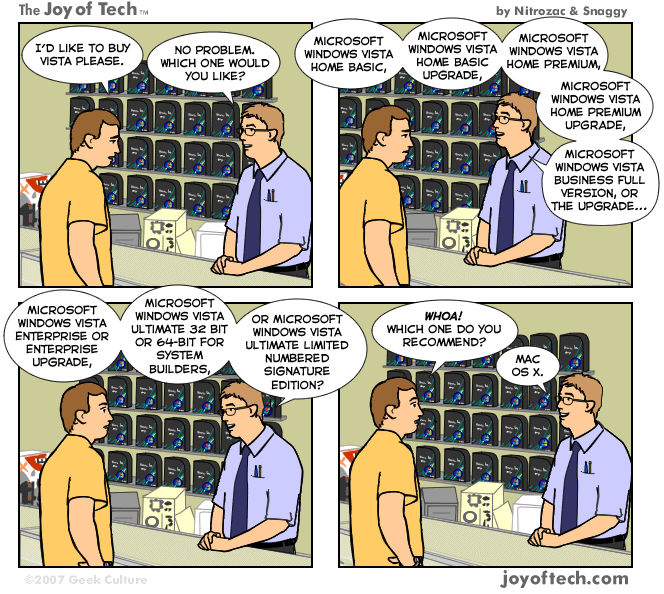
This entry originally appeared in my Myspace blog. Here are the comments as posted:
Posted by Eric on Friday, February 02, 2007 at 2:06 PM
The boys at Penny Arcade had a similar riff, too.
Posted by Naughty by N8ture on Friday, February 02, 2007 at 2:52 PM
Haha... Ain't it the truth! ;)
Posted by james on Thursday, February 22, 2007 at 4:27 AM
Brillant! And yes aint that the truth!!LOL
Subscribe to:
Posts (Atom)
 Ben Alpi
 Posts
Posts

