skip to main |
skip to sidebar
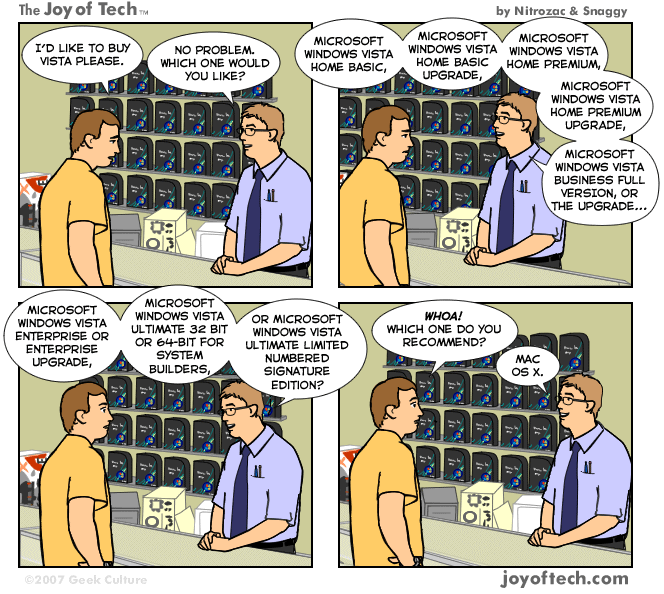
I was peering at Windows Vista at Amazon.com and found there are like 10 different versions. There's uhh Blue, Green, Light Green, Baby Blue and Blue-Green I think... I'm not sure, but you may have to buy all of them to get a complete OS. I wouldn't count on it though.
Others seem to agree with this sentiment...

This entry originally appeared in my Myspace blog. Here are the comments as posted:Posted by Eric on Friday, February 02, 2007 at 2:06 PM
The boys at Penny Arcade had a similar riff, too.
Posted by Naughty by N8ture on Friday, February 02, 2007 at 2:52 PM
Haha... Ain't it the truth! ;)
Posted by james on Thursday, February 22, 2007 at 4:27 AM
Brillant! And yes aint that the truth!!LOL
Microsoft is set to constrict and disable parts of your computer if you install Vista. I'm NOT kidding. Extensive research has been done by Peter Gutmann digging into the developer's guidelines and what he has found is nothing short of amazing. Or, amazingly bad. Perhaps even silly and certainly overboard. His article is over 30 pages long and is largely written for tech persons. What I'll try to do here is boil it down not point for point, but down to more "what it means to you." I think everyone needs to know about this. I've verified his findings with other sources although none of them go into this much detail. I still recommend reading it for yourself and looking into more sources (just Google "Vista copy protection" and you'll get lots).
Microsoft Vista intends to protect any and all "premium content" on your computer from piracy. It is attempting to force manufacturers to conform to an extreme set of standards that will ultimately make using a Vista PC a slow, limited, costly and low quality experience. What is "premium content?" It's hard to say right now because some older technology (like Super Audio Discs) seem to be included, but certainly included will be HD video discs.
In the new age of High Definition TV and discs like Blu-Ray and HD-DVD, it's understandable that the creators of shows and movies are concerned about having such a high quality version of their work in customer's hands. I would be! With an HD copy of a film, counterfeiters would have a field day selling pristine bootlegs which could kill the industry and then, no more shows or movies. What will happen when you pop in a HD-DVD movie into your Vista PC? Well, Vista will first recognize it, then it will go through and disable everything on your computer that could possibly be used to copy information. This is set to include any cables you may have sending a signal out to a TV or stereo receiver. That means if you have your computer set up like a DVD player (like one you may have built with with Windows XP Media Center) with a digital optical audio cable piping Dolby Digital Surround Sound to your reciever and one of many cables piping out video to your TV, those ports will be disabled and will not work. Why? Because there is the slightest of chances that maybe you've figured out a way to copy the picture or sound. 'Well, if it's disabling all these ports, what about my monitor?' Perhaps most interestingly, the "premium" picture and sound will be displayed on your monitor and out your speakers, but will actually be purposely filtered to be "slightly fuzzy". 'That's crazy! Vista is going to DECREASE the quality of the picture and sound?'Yes. All in the name of copy protection.
If you think that's enough to tempt you to moving to a Mac, there's more. The other thing this will likely effect for Windows customers is their wallets. You may have heard that you will likely have to upgrade your computer just to run Vista at it's minimum requirements. Pretty much anything over a year old will need to be upgraded. I had my 98/NT/Win2000/XP PC for 6 years before upgrading recently and it wasn't even close to to top of the line when I bought it. Now, I'll have to upgrade my 6 MONTH old computer in order to run Vista well. You may have also heard that Vista will require internet access so it can "call home" regularly to authenticate itself and upload hardware information about your computer (and we all know net access will be required to make Vista work correctly with umpteen "critical updates"). This includes businesses as well as consumers and some corporations are already refusing to adopt Vista until the "call home" function is removed. What you may not have heard however is that Windows is "asking" hardware makers to change how they make their computer parts in order to conform to Microsoft's copy protection requirements. One big sector that will be affected are video cards, which are "add-on" cards that many of us use to get better graphics in games and will be required to run Vista. Video cards have graphics processors which computes all video-related information on your computer. This greatly speeds all your graphics and reduces the strain on you're computer's central processor. Currently, most video cards have processors made by either NVIDIA or ATI and the circuit boards that are sold with the processors attached are made by someone else. Popular 3rd party board makers include XFX, EVGA, ASUS and BFG. To run a video card (and any piece of hardware) you need to install "driver." A driver is a little software application that "plugs" the device into the operating system and coordinates the two so they can work together. Right now, if you buy an NVIDIA or ATI-based video card, you can download a single universal NVIDIA or ATI driver that will make all cards with those processors work properly. This covers hundreds of cards from the last 4 years at least. How BFG or EVGA make video cards now, as noted in the article, is similar to a car. They make a universal body for a car to go around the engine with all the nice options and then remove options to decrease the price. "Options" are often extra functionality provided by an added chip. When the chip is taken away, it leaves a little empty conduit on the board. This void, so Microsoft says, is a security risk. So, instead of making a one-size-fits-all board with options-or-no, Microsoft is "asking" board makers to make custom boards for every price-level of a card. Furthermore, they're requiring that every graphics processor and every version of that processor (right now, NVIDIA has 12 in their popular GeForce 7 Series alone) must have its own driver. What this all translates to is more money for manufacture and that means either less choice for the consumer or a higher price, perhaps both. It also means that makers will have to create all new drivers for existing cards in order for them to work with Vista and from now on, make custom per-card drivers. (Many GeForce 8 Series users have complained about there being no Vista Drivers yet. I guess now we know why.) Not only does that mean that we'll have to dig through a ton of drivers to find the one that matches our video card, it means additional costs for makers and higher costs for us. And it means that there are thousands older of cards out there that manufacturers won't be willing to write new drivers for. I have a machine that runs on a 4 year old NVIDIA 5200. If I upgrade to Vista, it won't work anymore (and would be deemed a security risk, of course). There are thousands of businesses that have cards even older than mine in computers running Windows XP and simple programs like word processors just fine. If upgraded to Vista, it would mean possibly thousands upon thousands of "out moded" computers. The film Robots comes to mind. Every little variation of every device out there will have to have custom drivers and this includes every universal piece manufacturers have thoughtfully built-in over the years. Think of this as well, this could mean that my motherboard may not work either because that also has drivers and unused little spots on it-- your motherboard is the mama of your whole computer. Without her, you have no computer! Your DVD drive and your hard drives also have drivers. Will they be effected?
I also have to mention that Vista will only allow you to make a limited number of hardware changes to your computer before it must check your software license online. That means you'll have to be hooked up to the net and the new hardware will have to be approved by Microsoft in order to work. In not, your new hardware will be disabled. If you're a gamer and upgrade your video card often, Vista may soon require you to re-authenticate your copy of Vista or you won't be able to use the new device. In addition, if you're computer happens to have too many data hiccups or little electrical oops's from power fluctuations, outages or just plain who-knows-what, that will also trigger Vista's watchdog program and require you to connect to them online to show them your papers. This also means more info than ever before will be sent to Microsoft. The book 1984 comes to mind.
Wait, there's more! I mentioned Vista would slow your computer (nope, I don't just mean installing hardware). Mainly, it'll slow things down with its new copy protection system called Hardware Functionality Scan. This is yet another one of those "background services" that slow your computer although this one us supposed to be even worse. See, the HFS process is dynamic, meaning that it adapts to changes in your computer in real time. So, if you're playing "premium" music, the detection "fades" in and out when the music fades in and out. So, no only will the song be "fuzzy with less detail" because it's being purposely degraded, but your computer will be enabling and disabling components between every song! A Christmas tree comes to mind. All this activity will slow your computer and there's no way to turn off this "service."
I have no idea what all this will do to software and hardware makers. ATI has already stated that it's spent more in the last 6 months in legal fees related to this than it ever has before. These requirements promise to make software makers lives more difficult because they must conform to a very narrow and strict (and sometimes extremely vague!) set of guidelines. If you're a software maker of copy protection for films, it looks like you'll have to get your software approved by experts in the field, Hollywood studios. These changes are already making producers of open-source software wonder. As far as content producers like artists and musicians, instead of this being a simple and rewarding upgrade, there are thousands of hardware issues to consider. It also raises a lot of questions like, if you're like me and you create HD content, will it be degraded because it's HD? Heck, will we be able to watch HD trailers with Quicktime at full resolution? Will Quicktime even work on Vista? And who actually decides what is "premium content?" Will all your software and drivers have to pass a Microsoft approval process? Also, will Vista run on Macintosh computers with Bootcamp if we so chose?
What this all boils down to is a long list of limitations that borders on fanaticism that will ultimately degrade your computing experience. And Microsoft isn't asking anyone's permission. It's simply suggesting that businesses fall in line or else they'll be failing their customers (because we'll make your content look like crap). Personally, I haven't seen any copy protection that's ever worked. If things don't change, you will be paying for this copy protection no matter what because of all the dollars that manufacturers will have to spend to achieve the glory of a 'Microsoft Approved' certificate. From what I'm reading it will take a lot of hoop jumping and rigid, difficult programming. I think it's absolutely incredible that Microsoft would do this especially since the industry has been moving more towards open source (open source meaning anyone can create and contribute to software like Mozilla FireFox). It will likely encourage some people to make the leap to Apple, which isn't much of a leap being Vista largely imitates Apple's current operating system OSX. This effort by Microsoft is more strict and limiting than anything ever in computing and woe to anyone who simply goes along with it. It restricts your rights and violates your privacy no matter how your slice it. "Non identifiable information" just means they haven't put the pieces together yet. Years ago, there was a HUGE outcry when Intel put a "call home" capability into their Pentium III chips that sent them info about your computer. This is far worse than that.
I encourage everyone to look harder and deeper than I have and get the facts. And then make them and your opinion known. Don't just send your findings and feelings to tech mags and websites either, send them to national news outlets and to your congressperson. Our daily living should be about freedom and choice, not about artificial limitations supposedly in the name of security. And no business should be able to gathering information on us personally. If we want to build computers without having to study computer science, use them without being slowed down because of superfluous background services, if we want to enjoy high quality content without degradation, if we want to use it as our media center and if we don't want to have to pay premiums on top of premiums for these things we must get the word out. Consumers and business both must make their opinions known about this.
Thanks for reading. Hopefully your curiosity is piqued. Please do let me know what you've found out and what you think. I think I'm going to browse for my new Mac with a nice HD monitor.
This entry originally appeared in my Myspace blog. Here are the comments as posted:
Posted by Naughty by N8ture on Wednesday, January 17, 2007 at 11:12 AM
All I can say is I hope Apple is prepared for all the new business they'll be racking up from this one!
Posted by Eric on Wednesday, January 17, 2007 at 3:33 PM
I've maintained for a while that Vista is, in many ways, MS putting the barrel of the biggest gun it can find right into it's gaping, voracious mouth.
An analyst on NPR a few weeks ago ran some numbers -- for corporate/pro users, Vista would require, in order to function at maximum efficiency (and factoring in pro user software costs and the purchase of hardware that can actually RUN the damn thing), somwhere in the neighborhood of $5,000.00USD.
PER COPY.
It obviously won't cost that much to home users, but it'll still be pricy.
This could actually, once and for all, cost them a significant number of corporate/business users, because it's no longer cost effective in any reasonable way. Home users were always the bastard stepchild of the MS market (we're essentially the biggest, free software testing bed in the universe), but business users are the company's bread and butter.
It'll be interesting, to say the least.
-E
Disclaimer: This blog contains approximations and feelings, not referenced facts.
Okay, now for quite a while President Bush has maintained that he would change his strategy in Iraq, even decrease troop levels, if his commanders told him he needed to. Back in December, as he was asking TV networks for airtime to deliver his promised speech about what his "course correction" would be (if it needed to be corrected, of course) he was continuing meetings with his generals and commanders (active and retired) and others for their advice on what to do. Well, all the interviews I saw, no I didn't view any on FOX News, these fellows, including commanders on-the-ground in Iraq, all said that a "troop surge" of some 15,000-30,000 troops to secure Baghdad was a bad idea. Even behind closed doors, Pentagon officials told reporters that a troop surge to confront a civil war would only result in a quagmire. Then something changed. Gloria Borger of CBS News (who I really can't stand) said the oddest thing. Although I can't find a transcript, I did rewind and re-watch what she said the night of. She said something to the effect of '...the President hasn't gotten the answers he's looking for yet...' (from his commanders) so, he's going to postpone his announcment. Soon after that, commanders in Iraq were quoted as saying a troop surge would work and the Pentagon was expected to recommend a troop surge. Now, top commanders in Iraq are "retiring". WHAT THE?!
I'm no conspiracy theorist, but this is just a little too weird not to point out. At first glance, Borger's reporting might seem normal, but if you look at it again, I think it contains an interesting idea. Could it really be that the President, instead of seeking the advice of his top people, just wanted someone to agree with him? And, when he heard all this "cut and run" talk, he postponed his speech until he could find people to agree with him? I'm sorry, but from the outside this sure looks like 'I've already made up my mind. Agree with me... or I'll find someone who will.' Of course, that would be followed by 'Ya fie-yud.'
Did anyone else out there notice the change of opinion of the Pentagon and commanders in Iraq? Anyone else find it somewhat odd?This entry originally appeared in my Myspace blog. Here are the comments as posted:Posted by B on Friday, January 05, 2007 at10:25 AM
I agree completely Ben ... but don't get me started on this administration. It's not good for my health.
... 726 days remaining ...
Posted by Ben'jamin on Sunday, January 14, 2007 at 1:54 PM
Haha. I hear ya, bud. Now he's addressed the nation and told us exactly what we thought he'd tell us a month ago. So, if he had already made up his mind, why did he consult with anyone? "If ya got a better idear, let's hear it."Uhh, well, I guess THAT depends on a.) Listening. and b.) Who is saying what is "better." I think he's already displayed his lack of "A" and he's the guy who has control over "B" so... I guess we're just going to do whatever he wants regardless.(If not even a bi-partisan study group of learned individuals can't sway him... Hey, wasn't Secretary of Defense Gates part of that group? Hmm... I guess the President must be pretty persuasive...). In the end, I guess I'd just like to know how much $$ it took to NOT listen to all those people he "consulted" with and how much it cost for the TV time to tell us what we already knew. Silliness!
I happened to be meandering around the internet and found the site to an interesting indie film named Gamers. If you'll take a look at their site, you'll soon notice they've cast a slew of iconic, though unexpected actors. (Reminds me of Comic Book: The Movie in that way). If you were a kid in the 70's-80's like I was, you recall fondly Kelly LeBrock (Lady in Red, Weird Science), Beverly D'Angelo (National Lampoon's European Vacation), and William Katt (Greatest American Hero) as well as John Heard who's just great. One name you may not recognize in the credits is actor-turned-voice actor Michael Bell. He did voices in Superfriends, G.I. Joe, Transformers, Smurfs and a whole lot more and narrates Gamers. He's really the reason why I'm writing this see, I have a huge respect for voice actors since I grew up on radio stories (on cassette, that is) and cartoons and thoroughly enjoyed the truly talented VOICE actors. The amazing depth and life they gave the character had a huge impact on me. Over the last 10 or more years though, voice actors have been widely traded for celebrities and cheap labor. In a little interview snippet on the Gamers site, Mr. Bell had this interview question to answer...
GAMERS: Your industry credentials are extensive, to say the least. What would you say are some of the biggest changes in film and audio recording since you started your acting career?
MICHAEL BELL: Stars, friends of the producers, real gangsters and sock puppets are being cast in jobs I used to do... although I still do a mean sock puppet.
Here here! Now, Mr. Bell is certainly not hurting for work, but I've watched more and more animated features turn to celebrity instead of quality and more TV shows go from quality to people off the street (I suppose). The voice is something that used to be very important in animation and live action alike. And I don't understand why the art of speaking-- enunciation, projection, tone, emotion-- has become so unimportant to so many content producers. Although Comic Book: The Movie had its slow parts, I loved the inclusion of so many voice actors. Mark Hamill, the star and director of the film, has become an amazing voice actor. (Side Note: Mr. Hamill was a stage actor before he was in film and watching some DVD extras of the animated series Justice League, the cast talked about how stage actors seem to make the leap to voice acting a little more gracefully since when on stage, their voice has to reach the furthest ear and be understood). I think when there is so much care put into the writing a piece for stage, video game, TV or film, the creators owe it to the writer and the audience to make those words sound as beautiful as they're written. There is such a beauty to the spoken word. Check out an old radio drama, cartoon, TV show or movie and you'll see what an amazing effect well delivered lines can have. It may not always be "realistic," but it's always entertaining.
To all the aspiring and professional entertainment creators out there, please take note of the enriching qualities of casting a great voice. And don't be afraid to cast a great actor who fits your role even if he or she isn't a big name. Maybe with your help they'll get to be one, you as well. And for anyone making the next great cartoon or video game, make your producer or backers spend the extra money on great voices. They're often the funniest and easiest people to work with and they may even help increase sales. And no matter what, when you look back at what you've created, you'll always feel rewarded because you cast the right people for the parts. Kudos to the creators of Gamers.
This entry originally appeared in my Myspace blog.
There have been some murmurs and now some hype about a 2008 Star Trek film possibly featuring a young Kirk and Spock as cadets back in the good old days of Star Trek. Here's a great article that collects the various tid-bits and clues floating around the world.
Personally, I don't know if JJ Abrams can do a Trek film justice. I feel it must be pointed out that in addition to shows like Alias and Lost, Abrams also created Felicity. Although I liked some of Alias, I find many of the storylines in Abram's shows to be simply preposterous; much like the film Armageddon (which he also wrote). When talking The Original Series (TOS) Trek we're talking about pulpy sci fi hits hard-science science fiction-- that's a difficult balance. Kirk has to get the ladies, but that can't be the whole show. The film has to make a profound point about society and the human condition; which to me is the guiding light of science fiction and is something the original series did well on many occasions. With Abrams at the con, this could quickly descend into NCC-90201. I like Abrams more than Michael Bay, but the two seem to have certain similar sensibilities about (not) developing realistic and compelling characters and storylines. I don't want to apply guilt by association, but other people who have worked along side Abrams also helped create Bay's horrible The Island and will soon crush the hopes of millions of Transformers fans when that disaster of a film is finally released (in which the similarities of the film to the original franchise pretty much end at the Autobot symbol). Is this really the guy we want? Should it matter that he's associated with (potential) franchise-killers? Well, I have to say that there are so many better creators out there who are being ignored. Wouldn't it be better to dig a little deeper and build a creative team of people who have been dreaming of creating Trek for a little longer or a little more? Abrams may call himself an Uber-Trekkie, but I can't see someone creating Felicity when he really wants to make Trek. Overall, Paramount has done a lot to lose the trust of Trek fans. Now that they own the franchise, CBS has only continued the erosion by announcing that in their forthcoming HD re-release of Star Trek: TOS they will be replacing many of the original special effects with new CG effects. Not only does that sound, well, really dumb and an extreme waste of time, to some, it's even sacrilegious. (Heck, as a visual effects artist, I think it's at the least dishonoring our visual effects heritage. One can only hope that, like the DVD releases of Doctor Who, you can turn off the replacement effects. And those original effects were REALLY... underfunded). If they're going to win back the trust of Trek fans, they have to show reverence for what has come before and make up for the poor choices they've made since The Next Generation. Not bringing Berman and Braga back might be a step in the right direction, but it won't heal the wounds.
Is the future-past story concept is a good one? Well, it may provide some fun situations and give the creators a chance to explore the characters and the Trek Universe in a different way. It may also free them from trying to continually stretch the TNG storyline as Berman/Braga did, which may be a boon. It may also be a chance to make up for the TNG mold they forced Enterprise into. The thing that this storyline would definitely have going for it is something that none of the later series had: the strong bond between Kirk, Spock and Bones (well, Data and Geordi, Paris and Kim were probably closest). I'm not saying that the others should have had that, but if you're going to use these characters, you have to include the genesis of that close friendship. As far as the look and feel of a film like this, clearly, CBS/Paramount et al are indicating that the old gold and blue colors will make a comeback, but I don't think you can make a feature film today that simply uses the same exact designs as the 60's show. Doing so would imply a certain tongue-in-cheek attitude that might not work if you want the audience to judge the film on its laurels and not as just some homage or parody. You need more detail in the designs or they'd end up looking cartoonish. Perhaps you have to start at the beginning, look through the prism of TOS and say "Okay, if the original series had money and things like laptops and cell phones had already existed, what might the series have looked like?" I think some of the costume and production designs for the TOS-crew films were brilliant, but much of it didn't really reflect The Original Series. The inspiration has to be there if fans are to enjoy it. And lastly, cast people who fit the roles, not just pretty faces. Say what you will about Shatner's acting, I think it takes a solid actor with the right attitude and even the right voice to pull off a character in sci fi. And that goes for crew as well. Don't hire someone to direct your film simply because he has some hit series and is a hot commodity in Hollywood. For both actors and crew, I think Hollywood is trapping itself inside ever-contracting bubble sort of like Washington D.C. Instead of actually looking for the right people to fill roles, Hollywood is limited by its rolodex. If so-and-so isn't in the rolodex, they don't exist. And we wonder why box office numbers are falling? Every community needs fresh blood in its gene pool or it will corrupt and die out. And fresh blood pumps in the veins as much in older individuals as younger. New people mean more risk, but the lack of risk-taking is probably the other biggest thing killing Hollywood. (Heck, if you wanted to choose a proven commodity, why not ask Joss Whedon, creator of the Buffy the Vampire and Firefly series? Now that could be cool!)
In the end, a good Star Trek story is much larger, much deeper and much more fun than any soap opera drama or action show set in contemporary times. Because of that, this film may be beyond JJ Abrams and many, many others, but if he can look beyond the immediate and finds the right people, young and old, Hollywood and not, he can make a truly amazing film. And, he can use his clout and popularity for good and make that big corporate conglomerate care about what they're making. Unfortunately, to do any less will mean the end of the franchise. (At least we'll still have New Voyages!)
That's only my jaw flappin' though. What do you think?
This entry originally appeared in my Myspace blog. Here are the comments as posted:
Posted by Tantra on Friday, January 05, 2007 at 9:21 PM
I can appreciate your sentiments on this subject. Do you work with New Voyages? If so, I look forward to meeting you sometime. I'm with Farragut.
Holly
Posted by Ben'jamin on Friday, January 05, 2007 at 9:54 PM
Thanks Holly! I guess you could say I'm a little passionate about Trek and other great sci fi. I do work with New Voyages and I don't think I could forget who you are, Lt. Commander. Fair wind and calm seas to the cast and crew of Starship Farragut!


 Ben Alpi
 Posts
Posts

